
Value-First AI Daily - Aug 10, 2026
Hosts: Chris Carolan, Nico Lafakis
August 10, 2026
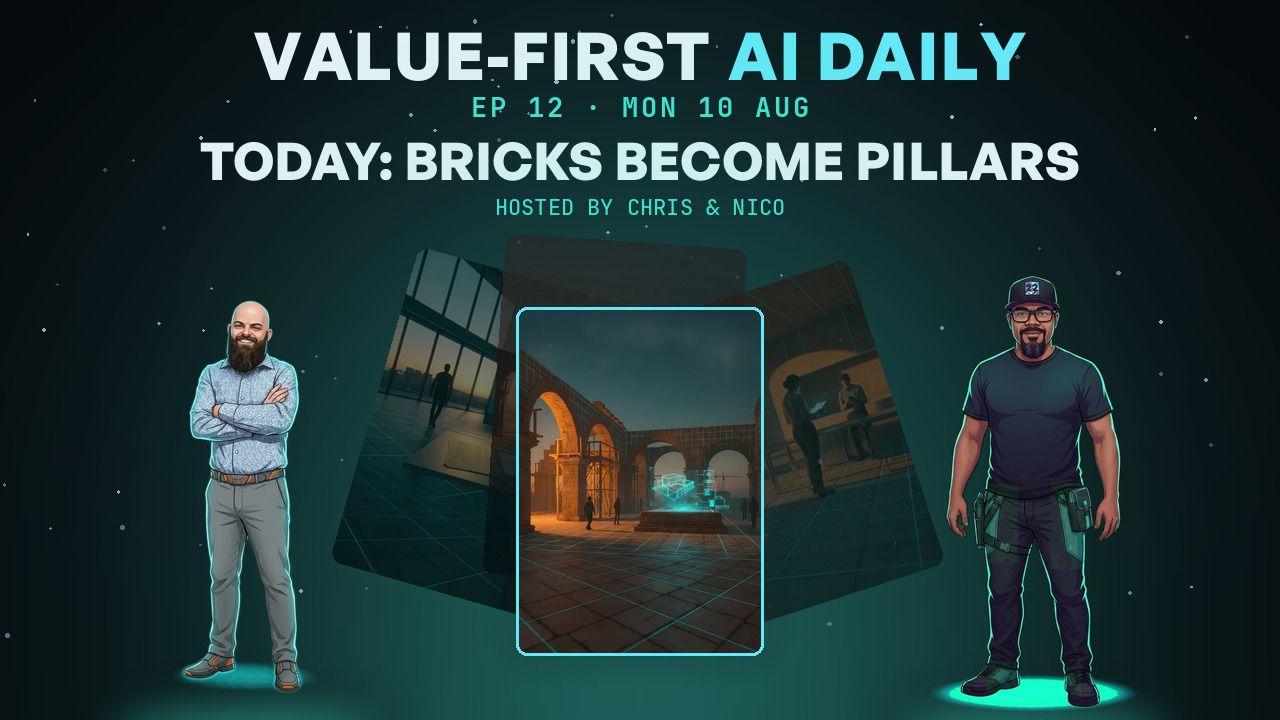
Ep. 12, Monday, both hosts, 47 minutes. Opens on a weekend setup story — a PlayStation controller mapped to full mouse-and-keyboard PC control so the work can happen from the couch; the one thing voice would not parse was "open Antigravity." Then Nico screen-shares the Flywheel build: the sandbox has become the model and reference gallery for every other level, a coin shop with skins is in, partner logos are placed pending approval, and combo, achievement, leaderboard and multiplayer are going in now. The geometry finally broke out of uniform bricks into planks and full pillars. Top 3 ran mid-show, in reverse rank order — Anthropic's loosened biology limits, Meta's open-weight Muse Glimmer, and the AI-designed bacteria-killing viruses out of Stanford and the Arc Institute. The last third is open conversation, closing on hiring flight-sim players into air traffic control.
Moments from this episode
10 short cuts from this conversation.

 Nico Lafakis165 Hours Is The Average, And That's The Low Number
 Nico LafakisEvery New Level Is Better Than The Last One You Played
 Nico LafakisPlease Don't Call Me A Developer
 Nico LafakisRecord The Bug, Let The Model Watch The Video
 Nico LafakisThat's Too Much Intelligence To Solve Stupid Problems
 Nico LafakisThe Best Idea Since F1 Started Hiring Gran Turismo Kids




Key takeaways
The build-time ladder is the concrete number from this episode: sandbox about 30 minutes, Lower Manhattan an hour, Upper Manhattan two and a half, Brooklyn three, Boston close to six, Cambridge nearly 24. Ambition scales the cost; it does not collapse it.
The breakthrough in the build was geometric, not visual — planks where planks belong and full pillars instead of stacked individual blocks. Getting the model to stop treating one generic brick as the answer to everything is what added the realism.
Levels are deliberately left at the fidelity they were finished at, so the game visibly improves as you play forward: "every new level is like better than the last level that I played." A build log turned into a difficulty curve.
Debugging by video is now routine: record an MP4 of the glitch, hand it to the model, and it watches the footage and finds the cause. "It's scary. It's really scary."
A 30-billion-parameter open-weight model is only useful if you can run it. Over 55GB at full precision is more than any consumer card, so local means heavy quantization plus speculative decoding at roughly 24 tokens a second — and the rig quoted at $45,000-50,000 two weeks ago is now around $100,000.
The frontier-model reflex has a cost the show named plainly: "that's too much intelligence for me to use to solve stupid problems." The argument is for smaller purpose-fit models, not bigger general ones.
Published safety numbers are vendor-reported, and the episode said so on air — the 85% drop in biology handoffs and the per-surface figures are Anthropic's own, not an outside audit.
The AI-designed-virus result matters because the output had to hold up in physical matter, not on a benchmark — close to 300 candidates, 16 that worked, and a cocktail that beat E. coli strains already resistant to the original.
Logged hours are becoming a legible credential. The flight-sim argument — average around 165 hours, top tier near 800 — is the industrial-age resume being displaced by an auditable record of time spent building real capability.
"The only boat to get there is the slow boat." The tools collapse the cost of trying an idea; they do not collapse the hours that make someone actually good at something.
Keep learning
You just watched the work. Now build it.
The next step is doing it yourself — live, with people on the same path.
One signal-dense note when a new episode lands. No noise.