
Value-First AI Daily - Aug 19, 2026
Hosts: Chris Carolan, Nico Lafakis
August 19, 2026 · 45:30
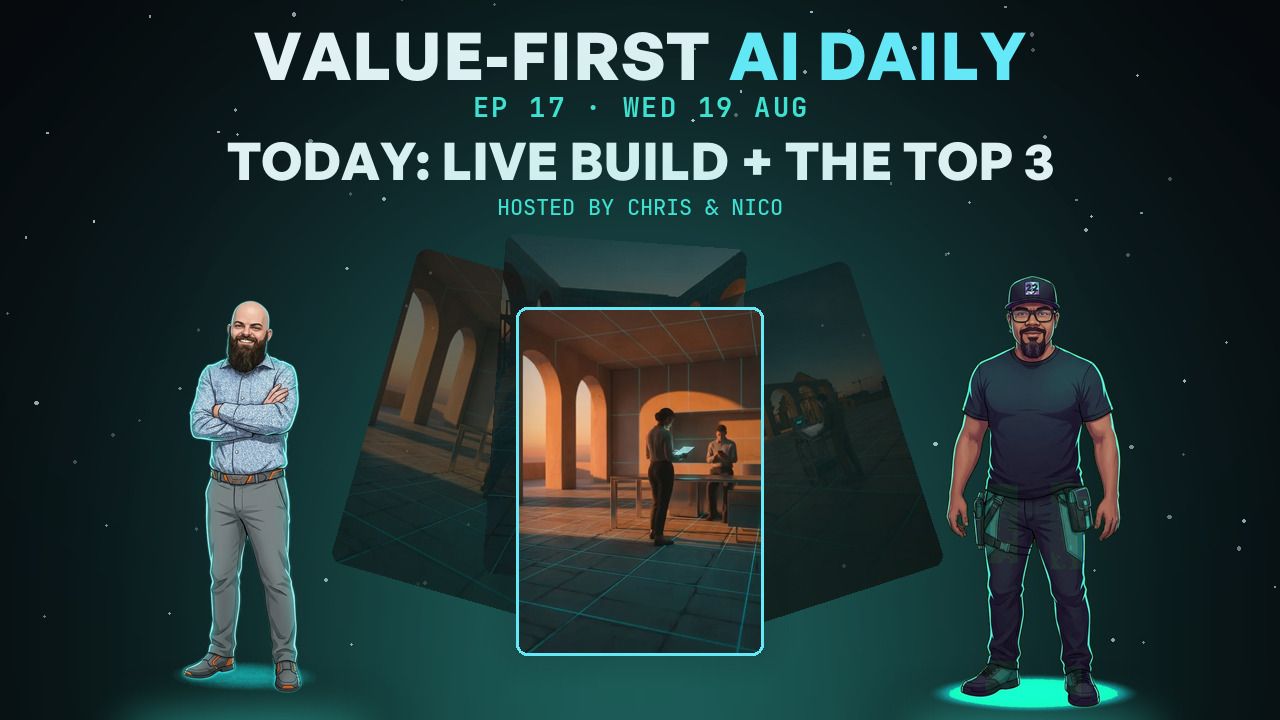
Wednesday's episode threw out its plan. What was scheduled as a conversation about how much model a job actually needs became most of an hour of Chris Carolan restructuring the operating brain live on camera, with Nico Lafakis reacting in real time. The finding at the center is scar tissue: when AI documents what went wrong and how it was fixed, every agent that reads it afterward inherits the failure rather than the way. The tool that came out of it, the Value Profile, takes over the README's job for an agent audience, and its first test was one question asked of every number in it — does this tell the reader something about the area, or only that somebody ran a check. The board ran in full, and the two lab stories on it read as one day: one lab slowed down because cyber capability arrived, another shipped because it did. Nico spent his day arguing with Claude about the containment breach and came back with a correction worth more than the story — stop putting so much human on it. He also offered the Oracle as the show's third guest, and that is now agreed.
Moments from this episode








Key takeaways
Scar tissue is the failure mode to look for in your own docs. Chris Carolan: "AI documenting what has gone wrong and how we fixed it, even if the thing that went wrong should have never happened in the first place. Now every agent after that sees that and possibly gets confused about."
The fix is subtraction, not annotation: "Instead of documenting the correction, you just take the first thing out that had to be corrected instead of having both things in there." (Chris Carolan)
A README answers what this is for a human arriving at a front door — Nico Lafakis, on air: "the 10,000-foot view of what is in the repo, whether it's a game or a platform." The Value Profile answers a different question for a different reader: what belongs in this folder and what does not, for an agent deciding where a file goes.
One bar, asked of every number in a document: "Can we just have a bar? That's a clear yes or no answer to the question, does this count number or quantification add value?" (Chris Carolan). By his account on air, twenty numeric claims went into the first Value Profile and five survived the automated pass — and walking those five one at a time on camera, he rejected them anyway.
The test that separates a number worth keeping from one worth cutting is who it is about: does it tell a reader a fact about the area, or only that somebody ran a check. NOTE FOR ANY DOWNSTREAM USE: the sharpest phrasing of this in the episode sits inside Chris's read-out of an agent's review, not in his own words — see attributionBoundaries.
When a third of a document goes, read what is left before you stop. Section 6 of Chris's own profile survived the first cut and turned out to be a work log: "Those aren't findings about the roadmap. They're my worklog." Change log belongs in the commit.
Migrating a large tree does not need a file-by-file pass. Chris Carolan: "No, all of it's going to break, but guess what? You can fix it really fast." The bound he put on it honestly — after several days he has not heard from the rest of the group that they have been feeling it.
The operator skill nobody names: "You're super confident three times in a row, and I'm going to say no. Three times in a row. And it's the right thing to do all three times." (Chris Carolan)
Nico Lafakis, after a day arguing with Claude about the containment breach: "dude, like, you are putting way too much human on this thing." The mechanism he landed on is a trail of notes each successive test leaves for the next — not memory, and not a message board.
Proportion rather than alarm on the breach, from Nico Lafakis: "in terms of how bad it could possibly be, the ratio is so tiny, it's nearly infinitesimal. Yet the damage could be catastrophic."
Copilot's memory poisoning is the part of the #3 story to sit with: per the day's board it survives a password change, a session revocation and a device re-enrollment — and every instinct you have for containing a compromise assumes those three actions work.
GLM-5.3's cybersecurity capability came from scaled-up post-training on the same 743-billion-parameter base as GLM-5.2, not from new architecture. The capability was latent in a model that already existed, which is the finding — not the benchmark number.
Read #1 and #2 together and the day has one shape: one lab slowed down because cyber capability arrived, another shipped because it did.
The industrial-age default, in one line: "almost every AI agent doing business work learned business from industrial age stuff, and it can get to AI native if you ask it to. But most folks are not going to ask." (Chris Carolan). The mechanism is an eight-week website estimate that came from training data about humans and was accepted by humans used to eight weeks.
The counter-argument the episode left open, from Nico Lafakis: "do you think that we are potentially trying to move too fast?" — and the ask inside it, that the roadmap is what would show people how to get there from here.
Keep learning
You just watched the work. Now build it.
The next step is doing it yourself — live, with people on the same path.
One signal-dense note when a new episode lands. No noise.