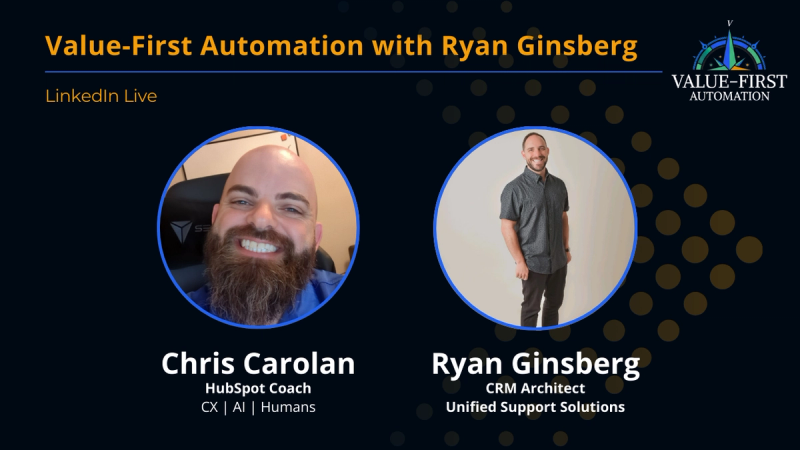
Ryan Ginsberg is an AI-native operating partner. Companies bring him in when the software they bought never became how the business actually runs — when the real work still happens in spreadsheets, chat threads and one person's head, and the system everyone was told to use is mostly where that work gets typed up afterwards.
Usually there is a more specific reason than that. The person who built it has left and nobody can edit what they left behind. The previous partner got most of the way and stalled. Or one capable person absorbed the whole thing on top of their real job and is running out of room. The common shape is a hole where the capability should be — the organization knows what it needs and has nobody who can build it — and the person he works with is whoever is standing closest to that hole. Often in operations or finance, and often the one who can name a number they do not believe.
That last part is the reliable tell. At a B2B lender the most common first-touch interaction in the entire portal turned out to be a broken service worker firing a phantom 404, so every attribution report was ranking a bug at the top, and at four hundred thousand contacts a wrong number and a right one look identical. Finding that is not the hard part. The hard part is what you do about it.
So most of the work is building. When settings and workflows hit their ceiling the answer is software. At Secured Tech, where the device, the repair event, the parts and labour and the invoice each lived in a different system, that meant one record per repair and two applications shipped into their portal — one a technician uses at the bench with the device in hand, the other the office uses to group finished repairs into a single itemised invoice. Elsewhere it has meant reverse-engineering an integration from its behaviour alone because the author had gone and the repository was lost, or commission logic that resolves the right rate from the partner's own record rather than a number hardcoded where nobody will find it.
Before any of that, the job is usually to make the problem smaller. "Integrate HubSpot with our ERP" is not a scope, and a lot of engagements start by narrowing an open-ended ask down to the two things that actually have to be true — which is most of the difference between a project that finishes and one that keeps growing.
The engagements that work best are ongoing and have a rhythm to them: a standing call, a short list agreed for the week, and the thing shown back the week after. That is deliberate. It is what lets a team watch the system get built instead of receiving it finished, which is most of the difference between owning what you were left and having to call someone.
That last part is what he is measured on. Cody Lopez, who runs customer success at Secured Tech, wrote: "They didn't build this portal for me. They taught me how to build it on my own. That's a fundamentally different kind of relationship." Cody shipped a production customer portal himself, months after the engagement had ended, and said that publicly without being asked to.
Most of the work now sits at the post-sale money seam — contracts, quote-to-cash, renewals — because that is where a signed agreement stops being data and becomes somebody's job, and where the cost of a wrong record changes shape: a bad deal is a forecast variance, and a bad invoice is a customer email.
He is direct about what will not work, which is usually the useful part of a first conversation. One client bought a reporting dashboard and was told the data underneath would make the dashboard lie, so the engagement became the architecture first instead. A migration that depends on a decision the business has not made yet is not a technical problem, and saying so early is worth more than a scoping document that pretends otherwise.
He co-hosts Another Orange Morning, a weekday HubSpot show, where the work gets done out loud and the answer stays public whether or not it flatters anyone. Between mornings he is inside real portals, which is the only reason the show can be specific.