
Value-First Data — Unified Revenue View Part 3
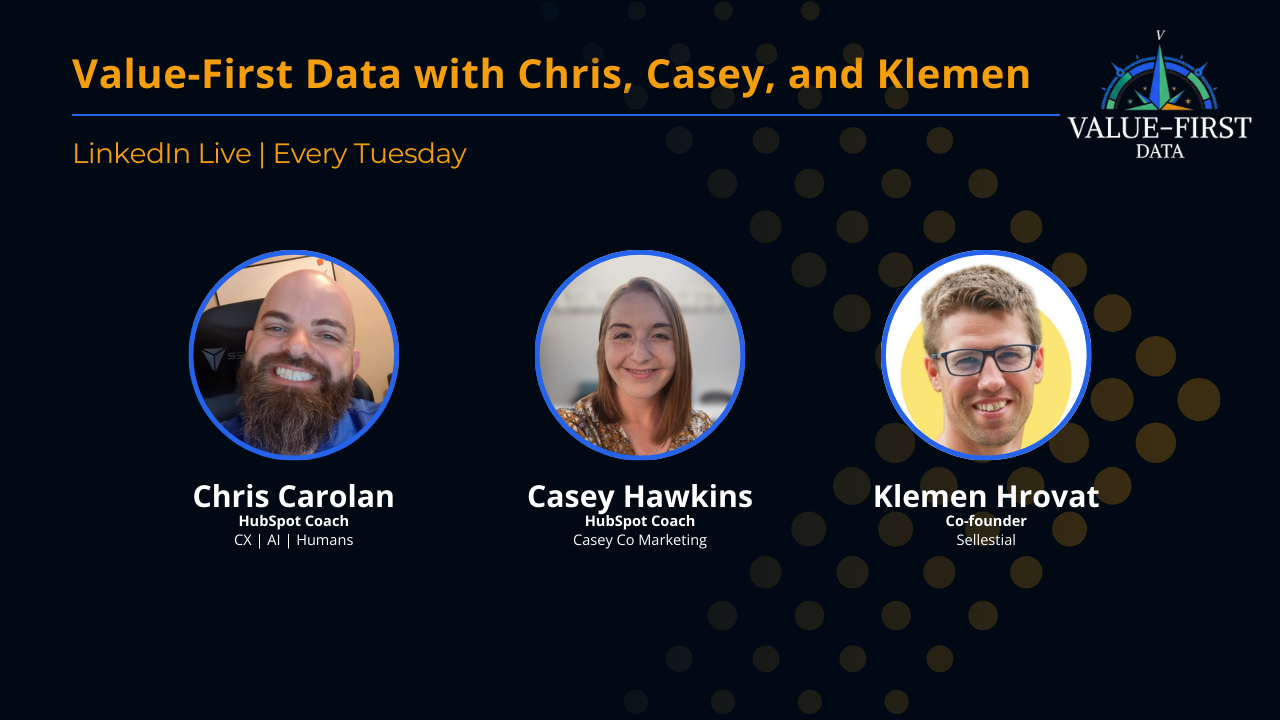
Hosts: Klemen Hrovat, Casey Hawkins, Chris Carolan
March 24, 2026
Part 3 of the Unified Revenue View series runs the playbook's current state audit: how you forecast, when you learn a customer is leaving, what happens after the deal closes, and how you find room to expand. The answers keep landing in one place: someone knew, but it was never captured.
Key takeaways
The current state audit is four questions: how you forecast, when you learn a customer is at risk, what happens between a signed deal and a successful customer, and how you find room to expand. They are simple to ask and hard to answer honestly.
A forecast is only as trustworthy as the numbers under it. Counting volume that doesn't predict revenue, like 2,000 marketing-qualified contacts when only 200 matter, produces a confident forecast that is wrong.
Forecast confidence depends on how your revenue is distributed. Spread across about fifty clients, Klemen's average held. Concentrated in one or two, it can't.
Stage-by-stage volume math can fit transactional, self-serve sales. Where value moves along a relationship and needs full context, it fails.
Forecasts often miss because of incentives, not data. People are rewarded for optimism, and a strong quarter can raise next year's goal so far that they learn to hold back.
Churn is rarely out of the blue. The person running the account can usually tell you its health more easily than a number in the system can.
Force the unified view, not the score. When you don't have the context to build a score, don't build one. A score without context causes bad decisions, anxiety and distrust.
The handoff from sale to delivery works when delivery has a say in what is sold, and when part of the seller's reward follows renewal rather than the signature alone.
Nobody asks for a unified revenue view. They ask to forecast better, see renewals, fix the handoff and expand. The audit is how you get from that request to the real gaps.
Run the audit without the tools in the room. People then describe the real, human signals they act on instead of only what software can track.
Record what people say and bring it back to a framework, or you will have the same conversation next quarter.
Resources from this episode
Transcript
This transcript was generated by AI and may contain errors. It is provided to help you skim and search the conversation.
Keep learning
You just watched the work. Now build it.
The next step is doing it yourself — live, with people on the same path.
Get the next conversation in your inbox
One signal-dense note when a new episode lands. No noise.