
Value-First AI Daily - Aug 12, 2026
Hosts: Chris Carolan, Nico Lafakis
August 12, 2026
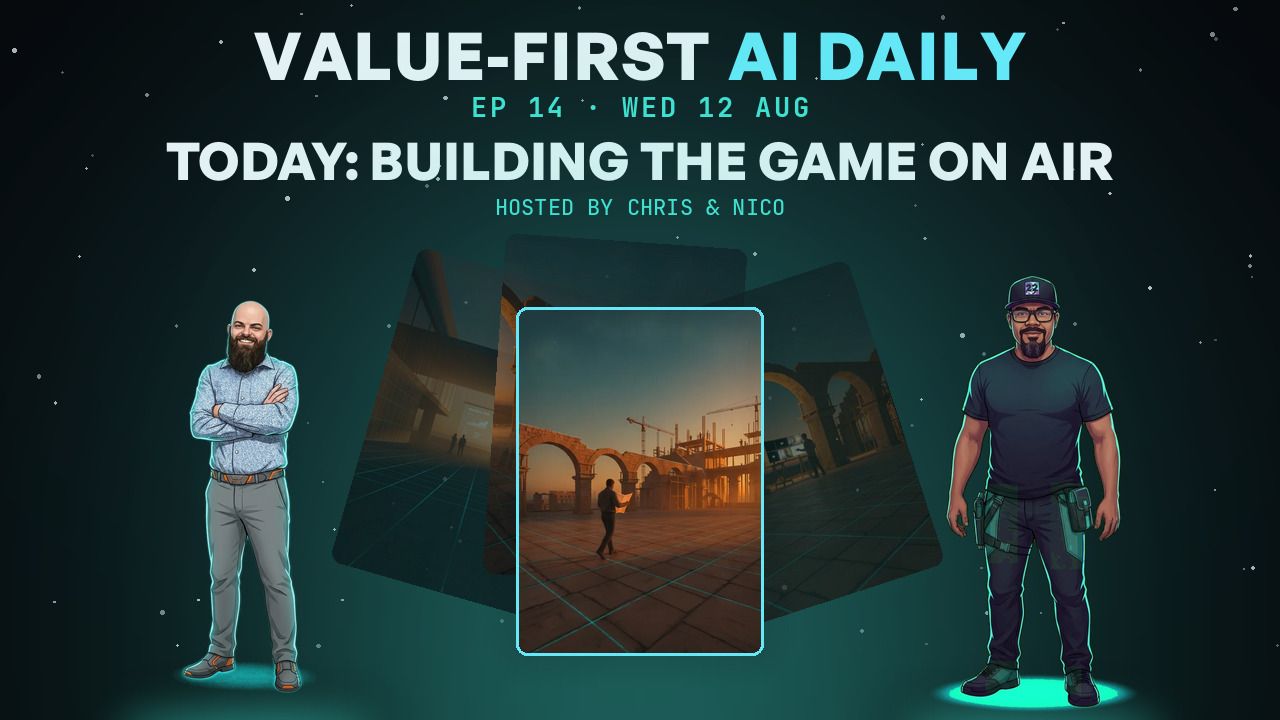
Episode 14 opened late and cold — no countdown on screen — and spent its first stretch on a new phone, which produced the sharpest idea of the day: at 120 frames per second, video finally matches eyesight, so Nico Lafakis now says anything slower is not real time. From there, a running argument about why people push back against abundance, a browser-game build demo that ran on camera, and only then the sealed Top 3, read at the back of the show rather than the front.
Moments from this episode
6 short cuts from this conversation.

 Nico LafakisAnything that's under about 140 or 135 frames per second is not real time
 Chris CarolanI wasn't thinking of you as a fellow human being
 Nico LafakisThe level of intelligence that you are getting per the dollar
 Chris CarolanWe don't need software subscriptions
 Chris CarolanYou don't get to learn AI unless you're using and building with AI
 Nico LafakisYou shouldn't do that because it's not difficult enough
Key takeaways
A capability quietly redefines a settled word. Nico Lafakis, after shooting at 120fps on a new phone: "Anything that's under about 140 or 135 frames per second is not real time, which is so weird to me now, right? Because now, even using the term real-time now means something totally different to me." (transcript line 74)
The argument against abundance is usually an argument about difficulty. Nico: "All of the reasons they give are almost in the sense of like, yeah, but you shouldn't do that because it's not difficult enough." (line 114) Chris Carolan's other half: "there's so much identity tied to things related to scarcity or, you know, specialness." (line 115)
Categorization collapses on contact. Chris, on what happens when the person you have abstracted is in the room: "it's literally, I wasn't thinking of you as a fellow human being. Like you were a number on a screen or you were like this, you know, caricature of a person." (line 119) His optimism is structural: mindsets move "in an instant" and, once moved, do not go back. (lines 137, 139)
You cannot ask a good question about a thing you have never built with. Chris, on the congressional hearings item: "You don't get to learn AI unless you're using and building with AI" (line 202) — which is why the board's number two turned into a conversation about institutional capability rather than about the disclosures themselves.
The board's number three is a financing shape, not a hardware story: Theseus Infrastructure — Anthropic, an asset manager and Singapore's sovereign wealth fund, with the model developer as anchor tenant and a commitment to cover consumer electricity price increases near those sites (sealed board, rank 3). Nico's read: "Well, if we can't control your progress by way of hardware, we'll suck up your money and your infrastructure so that you can't make progress that way." (line 167)
Meta's Muse Glimmer is the board's number one because of where it runs, not what it scores: 30 billion parameters, Apache 2.0, a single consumer GPU (sealed board, rank 1 — Meta's own published figures, attributed to them). Both hosts suspected a repeat and worked it out live: they had covered the same model from the full-precision angle, where the memory requirement put local use out of reach. Same model, opposite conclusion, one board apart.
The unit of comparison nobody publishes is intelligence per dollar. Nico: "somebody has to start doing the like, intelligence per dollar calculation for this stuff because that's about the only way that people are going to start to have respect for how very little money you are paying for what you are getting." (line 234)
On-device capability is a threat to a business model, not just a spec. Chris: "When we have super powerful AI models on our phone that don't need to talk to the cloud, that means we don't need software subscriptions." (line 259)
The build shipped visible progress and named what is still open. Landed on camera: per-level music including distinct shop and settings tracks, coin-and-skin call-outs, player profiles with shared record boards, reworked effects, and a performance pass aimed at phones and large maps — "I spent a lot of time on performance today just to make sure that people have a much better experience when you're playing the game" (line 153). Still open by his own account: multiplayer up to eight, game modes, AI opponents, a timer, power-ups.
The show keeps its own misses on camera. Chris found a board prepared for a Friday episode that never aired, read its top story live, and ribbed the operating org for it: "We give our agents, and I give my agents, a hard time sometimes." (line 254)
Keep learning
You just watched the work. Now build it.
The next step is doing it yourself — live, with people on the same path.
Get the next conversation in your inbox
One signal-dense note when a new episode lands. No noise.