
The Value Path - Aug 6, 2026
Guest: Joshua Oakes
August 6, 2026
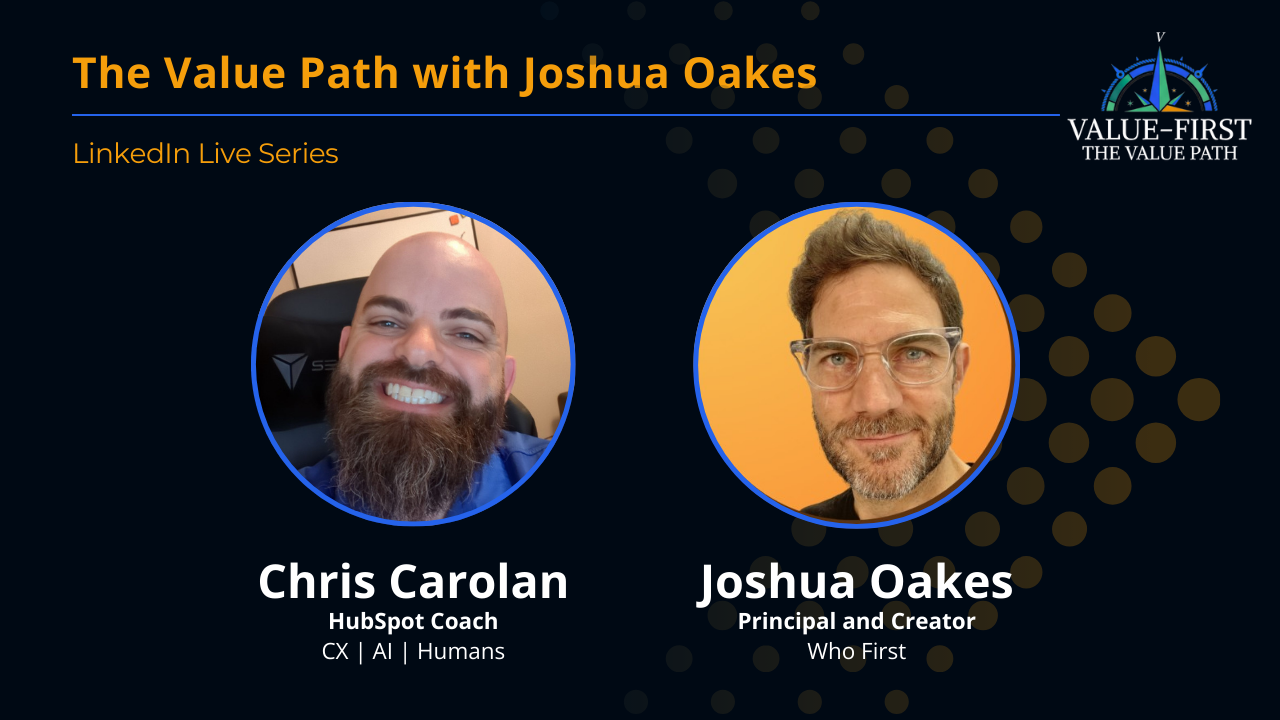
Joshua Oakes opens on rare-earth magnets — a physics lab, a broken engine repair, the platters they pulled out of destroyed hard drives — and then asks Chris Carolan whether the other kind gets him excited too. What follows is the argument that a lead form is a public document: phone number, company size, buying role, budget, timeline is your qualification criteria, shipped to anyone who looks at it. Joshua makes the harder case that being able to prove content ROI is a perverse incentive rather than a goal, and they land on the Hand Raiser stage of the Value Path — the person saying "I need help" — and the five things they are actually asking for when they say it.
Key takeaways
Your lead form is a public document. Phone number, email, company size, buying role, budget, timeline — that is your qualification criteria, shipped. At a larger company the employee-count dropdown ships your market segmentation too, telling a visitor which team they'll be routed to before they've met anyone.
Being able to prove content ROI is not obviously the goal. You can measure what you already published and you can never project what you haven't — so the goalpost moves and it gets harder, not easier, to make the thing that helps.
Watch what the email-capture number does to the work. Once teams are measured on how many addresses they collected, that metric starts steering the whole content strategy, and nobody has to decide it out loud for it to happen.
Notice when a threshold gets moved to hit a number. Chris's version, from the inside: "We might change our MQL scores a little bit to get more over the line. Even though sales was begging you for more leads, they don't want any of those leads." The volume arrives, the readiness doesn't, and both teams know it.
You do not need the email exchange to read intent. Leave the high-value pages open, track the views, and surface the record — this person hit these five pages that correspond with a high degree of intent, go ask what they need. Usefully close, without the gate, and the content stays shareable while you do it.
Count how many of the PDFs you've downloaded you actually opened. Chris puts his own number under one percent. If that's the real rate, the document was never the value — the email address was, and both sides of the form know it.
Tangible, shareable, multipliable — behind an email gate you get none of the three. Scarcity was doing the work gating relied on, and it's gone.
When someone says "I need help ___," they're usually asking for one of five things: help understanding their situation or problem, help defining what good looks like, help figuring out the path and what it costs and how long it takes, help building a case and anticipating objections, or help getting buy-in from someone on the committee who isn't sold. Nobody phrases it that way — they ask for a resource instead. Use it as a diagnostic on your own sales calls.
Make the content that disqualifies people, on purpose. Someone who learns a custom home takes a year and they're relocating in three months has been saved real heartache, and so have you. That is worth more than nine reasons they'd love one.
The answers already exist inside your company. Sales calls, service tickets and email threads are full of novel-length replies to exactly these questions. Go mine what you have before you commission anything new.
The guest

Joshua spent years consulting with organizations to help them solve product marketing and customer acquisition challenges.
Keep learning
You just watched the work. Now build it.
The next step is doing it yourself — live, with people on the same path.
One signal-dense note when a new episode lands. No noise.