The Value Path - Apr 16, 2026
April 16, 2026
Before someone commits to working with you, trust is potential energy. It exists in the space between what you've promised and what they believe you can deliver. Every conversation during the Path TO Value — every discovery session, every stakeholder meeting, every moment where you demonstrated understanding — built that potential.
At the Value Creator stage, potential trust becomes kinetic. Or it doesn't.
This is the moment where every promise comes due. And despite the fact that everyone on both sides knows this is coming, most organizations fail at it anyway.
The Value Path framework makes something visible that most go-to-market approaches ignore: the work of Stages 1 through 4 isn't just about closing. It's about establishing all impacted and involved stakeholders so that the transition to Value Creator is fluid and agile — not a jarring handoff where context disappears and relationships reset.
When that work is done well, the people entering the Value Creator stage have conviction, context, and organizational support. The individual contributors who were involved in the evaluation still have air cover from the decision makers who championed the purchase. The managers enabling team adoption understand why this was chosen because they were part of choosing it. The executives accountable for transformation outcomes can connect results back to the strategic case that was built.
When that work isn't done — when the Path TO Value was treated as a sales process instead of a stakeholder alignment process — the failure mode is predictable on both sides.
On the buying side: decision makers disappear after the commitment, leaving the individual contributors who were there all along without organizational support. The people doing the work lose their air cover. Managers are handed adoption responsibility without context. Executives demand ROI metrics disconnected from the original vision.
On the selling side: the relationship intelligence built during evaluation gets trapped in a CRM record. The new team assigned to delivery knows the contract terms but not the stories. The trust that was carefully built over months gets spent in weeks because nobody transferred the understanding of what this customer actually needs.
The Unified Customer View exists to solve exactly this problem. Not as a dashboard or a report — as a living picture of the complete relationship that travels with the customer through the transition. What do they need right now? Not what does your implementation process dictate — what do they actually need to become successful Value Creators?
That question — what do they need, not what's your process — is the difference between potential trust becoming kinetic trust and potential trust being lost entirely.
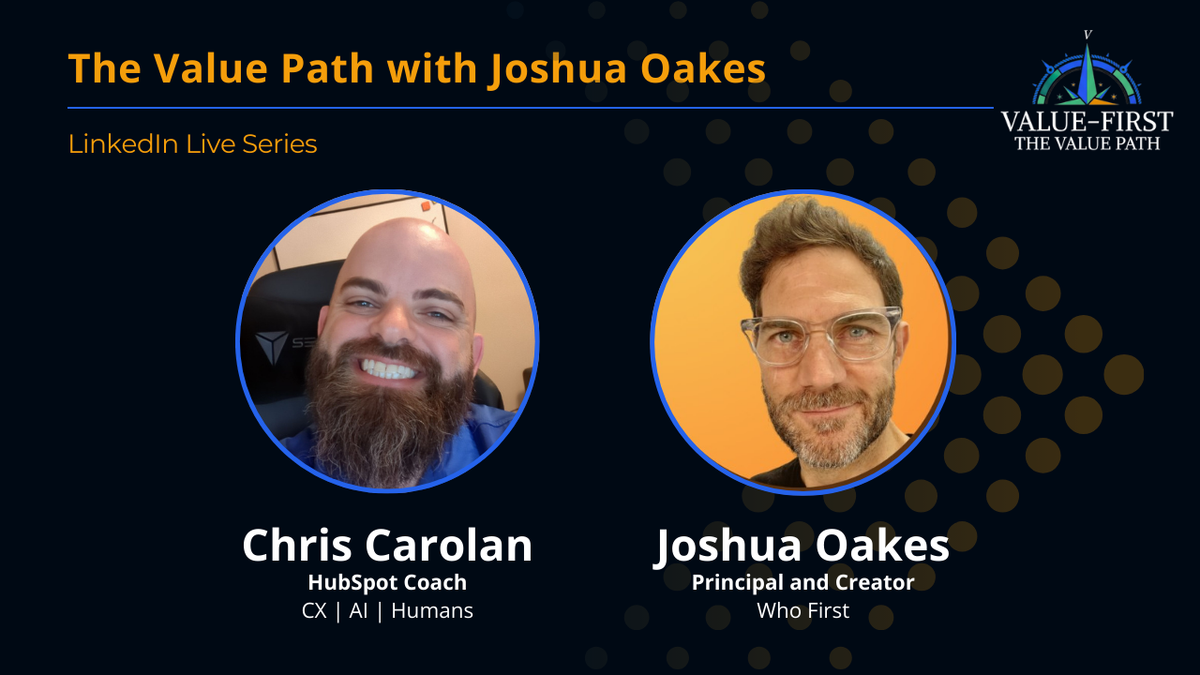
On this episode of The Value Path, Joshua Oakes and Chris Carolan explore the moment where promises come due. What the Path TO Value should have accomplished before this point. What happens on both sides when it didn't. And how the Unified Customer View creates the conditions for fluid, agile transition into the stage where real value gets created.
Resources from this episode
Keep learning
You just watched the work. Now build it.
The next step is doing it yourself — live, with people on the same path.
One signal-dense note when a new episode lands. No noise.