

You wrap a project. The final file goes out, the invoice follows a day later, and the card in your project tracker slides into "Done." Six weeks after that, the client doesn't renew, and you're genuinely not sure why. Nothing in any system you run ever asked the one question that would have told you. Not "did we finish it." "Did any value land."
That's not a motivation problem. It's a record-keeping problem.
The Ledger You Already Keep Only Answers Half the Question
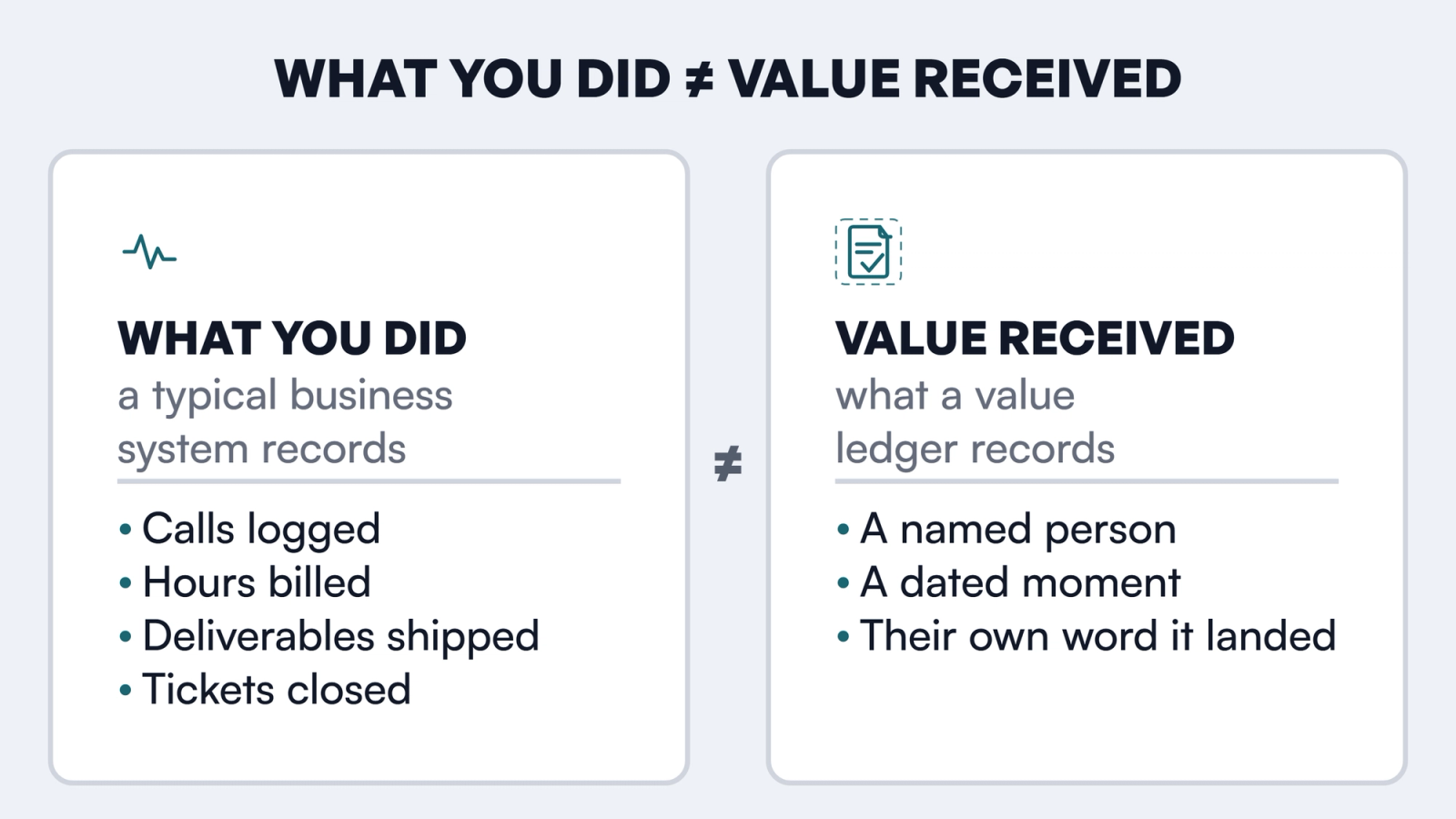
If you run a consultancy, an agency, a coaching practice, or any service business, you already have a detailed, real-time account of what you did. Calls logged. Hours billed. Deliverables shipped. Tickets closed. What you probably don't have is a comparable account of the value anyone actually received. Nobody built the system for it.
None of this means stop tracking activity. You need to know what you did, for billing, for capacity planning, for your own sense of the week. The problem is narrower: a finished deliverable and a valuable one look identical in a project tracker. Both get the same green checkmark. One of them changed something for the person on the other end. The other one just shipped.
Ask yourself the plain version of the question: of everything your business finished this month, how much of the value can you honestly say landed, not guessed, not assumed, but actually confirmed by the person it was for? If the answer is close to zero, that's not a failure of effort. It's a gap nobody built a system for.
Keep a Second Ledger, the Way You Keep One for Money
There's a name for the discipline that closes that gap: Value Accounting. It borrows its shape from bookkeeping on purpose. You already keep a ledger for money: one line per transaction, dated, attributed, reconciled. Value deserves the same treatment.
One entry per moment of value. Not "the engagement went well." That's a feeling about a span of time, and a span can't be verified. "Maria used the dashboard we built to catch a billing error before it reached her board" is a moment. It has a date, a person, and a thing that happened.
Every entry names two people, and they have to be two different people: whoever did the work, and whoever received the value. That distinction is the entire discipline in one sentence.
Principle: the doer never confirms the value. If you built it, delivered it, or ran the session, your own account of the value it created is not evidence, no matter how sure you are. You were the one making it. You're the last person positioned to see whether it landed. The confirmation has to come from the other side.
Whose Word Counts
This is where the discipline gets tested on the case that trips people up: what happens when you are the one who received the value, and there's nobody standing over you to vouch for it?
The rule holds. It just resolves differently depending on which side of the entry you're on. The doer's own word about the value is never enough, whether the doer is your newest hire or you, the owner, on your best day. But the receiver's own word is exactly enough, always, with no exception for rank. If a piece of software, a mentor, or someone on your own team gave you value you personally used, and you're the one who benefited, your own account of it is the confirmation. Nobody needs to co-sign it. You were the one it happened to.
The asymmetry is the whole trick: doing the work and being close to it are not the same as receiving it. Only the receiving side gets a vote.
Two Books, Never Added
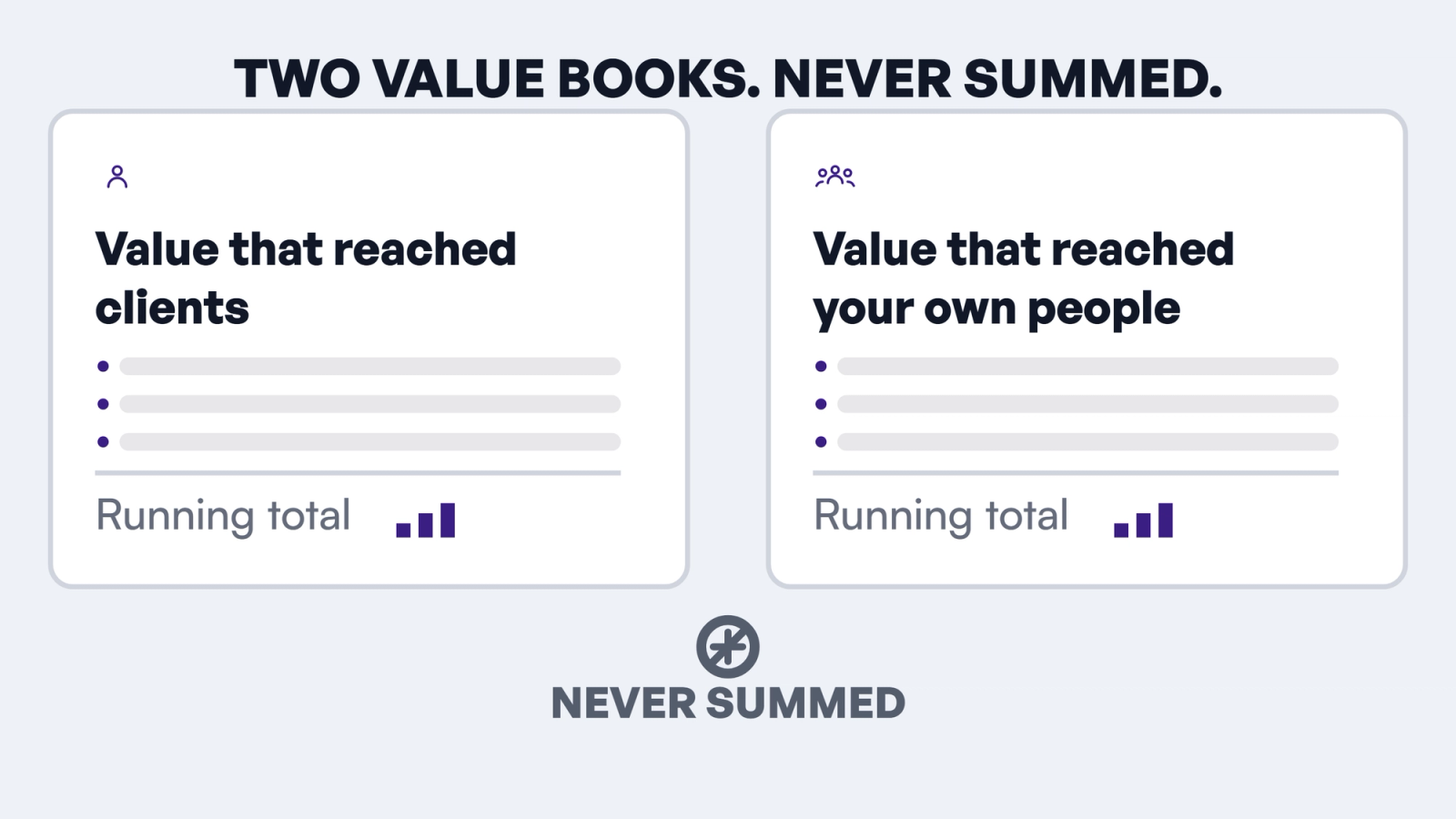
Keep two separate books, not one. One tracks value that reached the people paying you: clients, customers, members. The other tracks value that reached your own people: a teammate who can now run a report unassisted, a contractor who stopped needing you to explain the same thing twice.
Both are real. Neither should ever be added into the other to make one total. The moment you combine them, you've built a number that can climb because your internal team got more capable, while your actual clients received nothing new that month. The combined number won't tell you which one happened. Keep the books side by side, checked against each other by eye, never summed into a single figure that hides which side moved.
Four Rungs, and Most Claims Never Leave the Bottom One
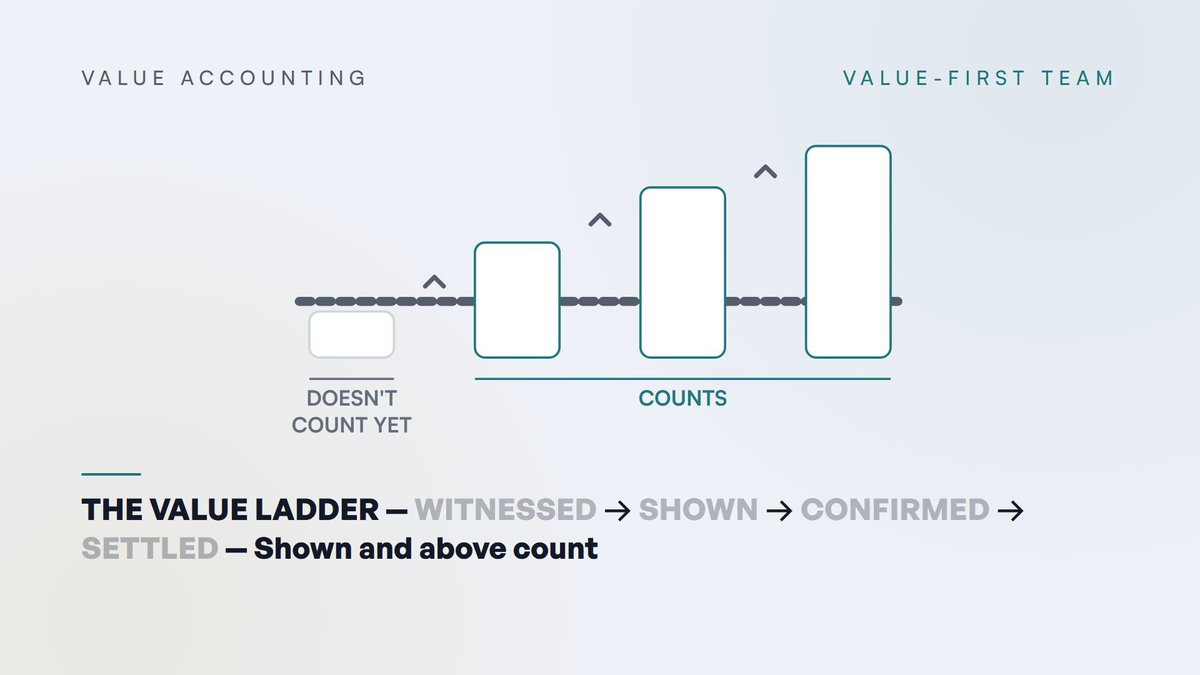
Not every value claim carries the same weight, and being honest about the difference is most of the discipline. Think of it as a short ladder:
- Witnessed: something happened, and you, or someone on your side, saw it happen.
- Shown: you put the actual evidence in front of the person it's about, so they've had a real chance to react to it.
- Confirmed: that person told you, in their own words, that the value landed.
- Settled: money moved, or a deal closed, and the timing traces back to it.
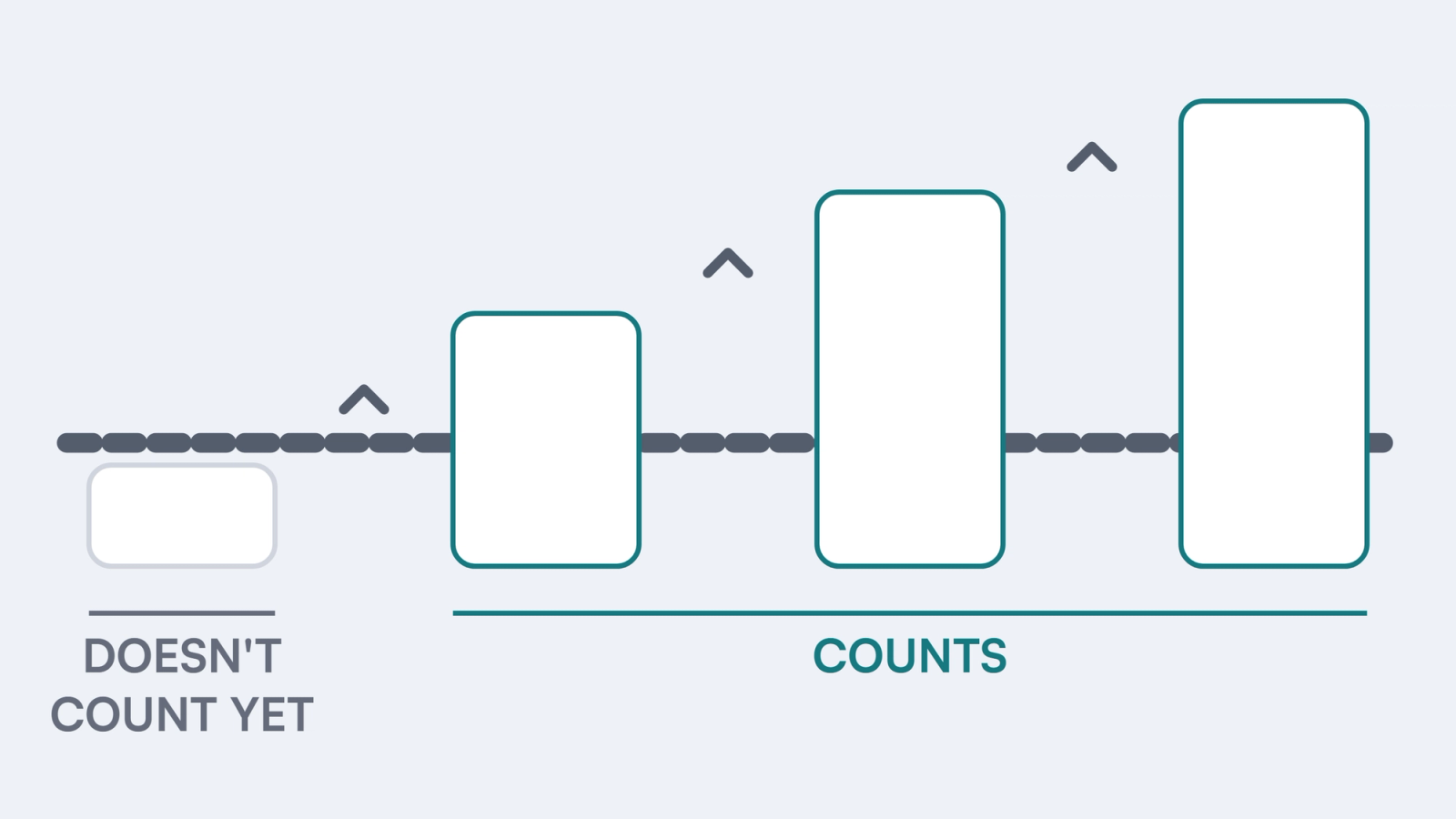
Shown, Confirmed, and Settled all count as real. Witnessed alone doesn't, and Witnessed is where most value claims actually die: not because they're false, but because nobody ever put the value in front of the person it was for. You saw the client nod on the call. You never said a word about what that nod meant, and neither did they, so the value sat in your head instead of in front of them. The move off Witnessed is the whole discipline in miniature: show the value to the person it was for, on purpose, then ask for their word.
What an Honest Month Looks Like
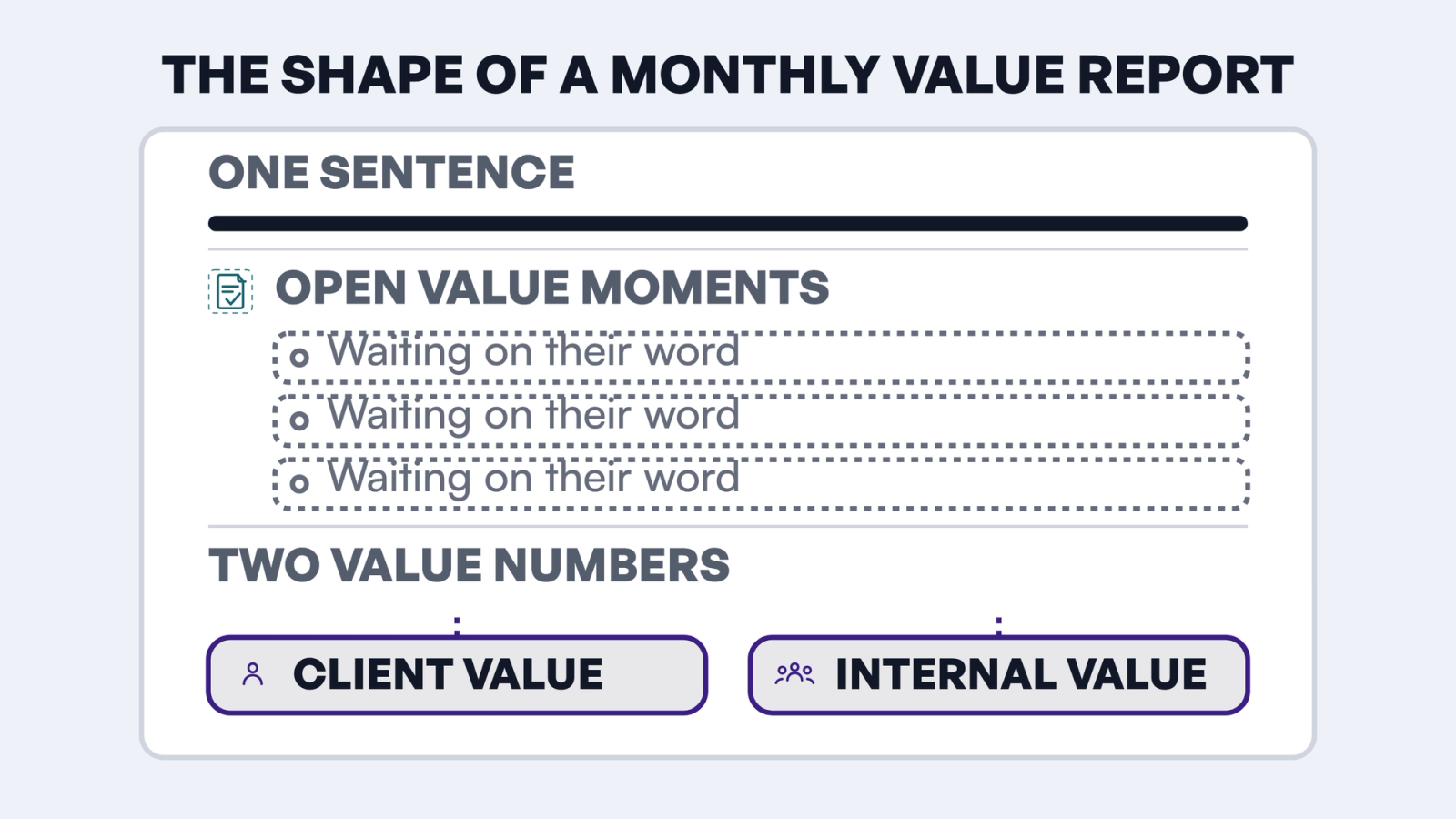
A month closed on this discipline doesn't read like a dashboard. It reads like a short memo. One sentence stating plainly what actually happened this month: good, bad, or quiet. Beneath it, the list of moments still waiting on someone's word, visible and un-hidden, because an open question isn't a failure. It's just still open. At the bottom, two numbers: client value and internal value, never combined into one. Every number opens back up to the real moments that produced it. No leaderboard. No target. No rate per person. A number you can't trace back to a name is a number this discipline refuses to produce.
One thing worth saying plainly here, because overselling it would break the exact honesty this discipline is built on: we're early with this ourselves. Two moments of client value are confirmed so far, both from this past August, with a handful more confirmed on the internal side. That's not a case study yet. Judge the discipline on whether the logic holds, not on a result that's still being written.
Open Yours This Week
You don't need new software to start. You need one view, four columns, inside whatever system already holds the record of the person: the moment of value (dated, specific), who received it, who did the work, and their own words, when you have them. Every time you finish something, before you mark it done, ask the actual question: who received the value, and have they said anything about it yet? If they have, write down what they said. If they haven't, leave the row open and go ask.
You'll notice the gap immediately. Most rows will sit open longer than feels comfortable. That discomfort is the point. It's the same discomfort a real bank ledger produces when a number won't reconcile. It means the book is telling the truth instead of the story you'd prefer to hear.
The businesses that hold up over the next decade won't be the ones that did the most. They'll be the ones that can say, line by line, who received value, and who told them so.
Worth passing on?