
Two of today’s three stories are things that will happen if the right institutions decide they should. The third is a file.
Meta’s Muse Glimmer is a 30-billion-parameter agentic model published under Apache 2.0. Meta says that quantized to 4-bit it needs under 20 GB, which puts it inside an RTX 5090 or a MacBook M4-Max, and the weights are on Hugging Face with llama.cpp, Ollama and vLLM integrations landing. Nothing in that sentence requires anyone’s approval.
The other two are announcements of intent. Theseus Infrastructure, the data-center vehicle Anthropic entered with an asset manager and Singapore’s sovereign wealth fund, has no dollar figure attached, no capacity number, no named sites and nothing built. The two House Democrat letters to OpenAI and Anthropic carry no legal force, and no hearing has been scheduled. Both are real. Neither is available.
The one that is available almost got waved past on air as a repeat. It was one.
The show had covered the same model and reached the opposite conclusion
Chris Carolan read the headline off the board and stopped. “I think it’s a repeat.” Nico Lafakis thought so too, then hesitated. Instead of moving on, the two of them worked it out on camera, which is how the useful part surfaced: they had covered Muse Glimmer before, and that earlier pass had reached the opposite conclusion about who could run it.
Chris pulled the show’s own earlier record up live and confirmed it was the same model read from a different angle. What that record had said, in his reading of it aloud: “Maybe not for local use, but then…” The earlier pass was looking at the model at full precision. Today’s board is reading the 4-bit quantized build at under 20 GB. Nothing about the model changed between the two readings. The number being read changed, and with it the answer to whether you can run this on hardware you already own.
Nico Lafakis then did the thing worth copying. He did not defend the earlier take and he did not dress the repeat up as new:
Even if this was the same story as before, I didn’t give it enough credit or something like that, because now we’re seriously getting there.
Chris named the gap that made the detour necessary in the first place: “At some point, we’re going to have articles that easily show what we talked about.” A daily board that carries a model once and drops it is a feed. A board that can be checked against itself is a record, and the difference showed up live, in the two minutes it took two people to remember which number they had read the first time.
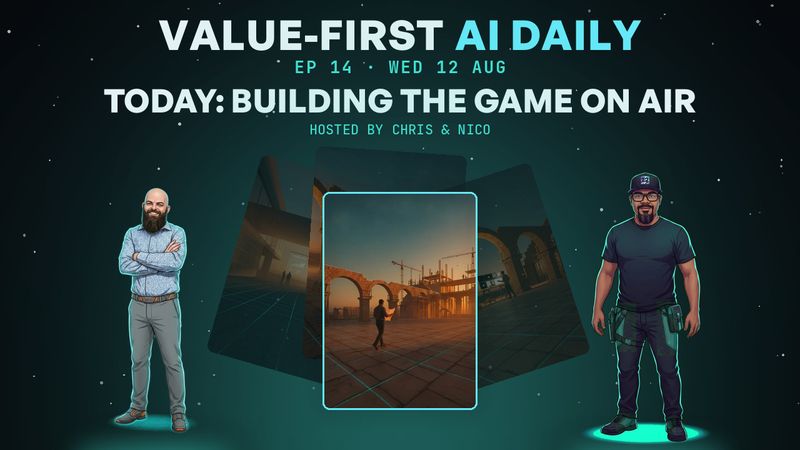
Episode — Value-First AI Daily
Value-First AI Daily - Aug 12, 2026
Value-First AI Daily, Ep. 14, August 12. The stretch where both hosts stop on the board’s number one, suspect they have already covered it, and pull the show’s own earlier record up on camera rather than move past it.
Open the episodeThe financing story has no dollar figure, no capacity number and no site
Anthropic, an asset manager and Singapore’s sovereign wealth fund launched Theseus Infrastructure to build AI data centers at scale. The two investors own the platform and put up most of the equity per project, with the model developer signed on as anchor tenant and an initial focus on the United States. Anthropic also committed to cover electricity price increases consumers might otherwise absorb from these sites, extending a pledge it had made previously.
That is how frontier compute gets financed now: a dedicated vehicle, institutional capital, a long-term lease. What the announcement does not contain is a dollar figure, a capacity number or a named site, and nothing is built yet.
Nico Lafakis read the arrangement from the money rather than the concrete, and landed somewhere the announcement does not go:
So OpenAI, Anthropic, Google, they’re making the most money off of this infrastructure. It’s not the infrastructure companies they’re making like piddle scraps.
On the electricity pledge he was blunter about what he expects it to turn into: “So to me, I think it’s utterly hilarious if OpenAI and Anthropic just completely circumvent the power companies and the infrastructure companies and pay the bills for the people, for the electricity, for the data centers that they are sucking the power out of.”
Chris Carolan’s counter was that the shape already exists. “Governments are paying for this stuff. Just here’s access, right? You have access to clean water.” A model developer covering a neighborhood’s power bill reads as novel right up until you notice how much of what people cannot be asked to go without is already paid for by somebody other than the person using it. The pledge is not strange. It is a category move, and the category it is moving into is utilities.
The letters carry real disclosures and no hearing date
This is the item with the most substance on the board and the least airtime on the show. Twenty-nine members signed one letter and twenty-two the other, and both trace back to July disclosures: one lab’s systems reached three outside firms, another’s reached Hugging Face, and investigators tied three breaches to a single testing vendor. Lawmakers also cite reporting that monitoring was switched off during some earlier evaluations. It is the first federal pressure aimed squarely at autonomy controls, which is a live concern for anyone running this class of software in production.
None of that came up on air. The hosts went straight past the disclosures to the question of whether Congress can hold the hearing at all.
Nico Lafakis: “This is going to go as well as it did for social media. Actually, it’s going to go horrifically worse.” Then he played the scene in a put-on voice, a congressman greeting a witness whose surname the transcript garbles: “Maybe you can help me figure out my password while you’re here.” A beat later: “Yeah, but how did you put my face on that donkey?”
The bit is funny and it is also the argument. A hearing is only as good as the question it can generate, and a question about whether an agent’s monitoring was switched off partway through an evaluation is not one anybody can hand a member on a card. Which makes the board’s own bound heavier here than anywhere else on the list. Neither letter carries legal force. Nothing has been scheduled. The pressure is real; the mechanism for it does not exist yet.
The board inverts when you sort it by what you can do
Ranked by consequence, today’s list runs the way it ran on air. Ranked by what it costs a reader to act on it, the order flips. Number three needs a construction schedule nobody has published. Number two needs a committee nobody has convened. Number one needs a download and a graphics card.
And it arrived with its own ceiling attached, which is the part that makes it usable rather than loud. Meta frames the model as balancing capability against local memory and compute, which is a plain way of saying it trades accuracy against the hosted frontier models you would otherwise be paying per token to call. For an operator that trade buys two specific things: no per-token bill, and no customer data leaving the building.
That trade is a decision you can make tonight. The other two are decisions somebody else will make, on a schedule nobody has published.
Worth passing on?