
Value-First AI Daily - Aug 18, 2026
Hosts: Chris Carolan, Nico Lafakis
August 18, 2026
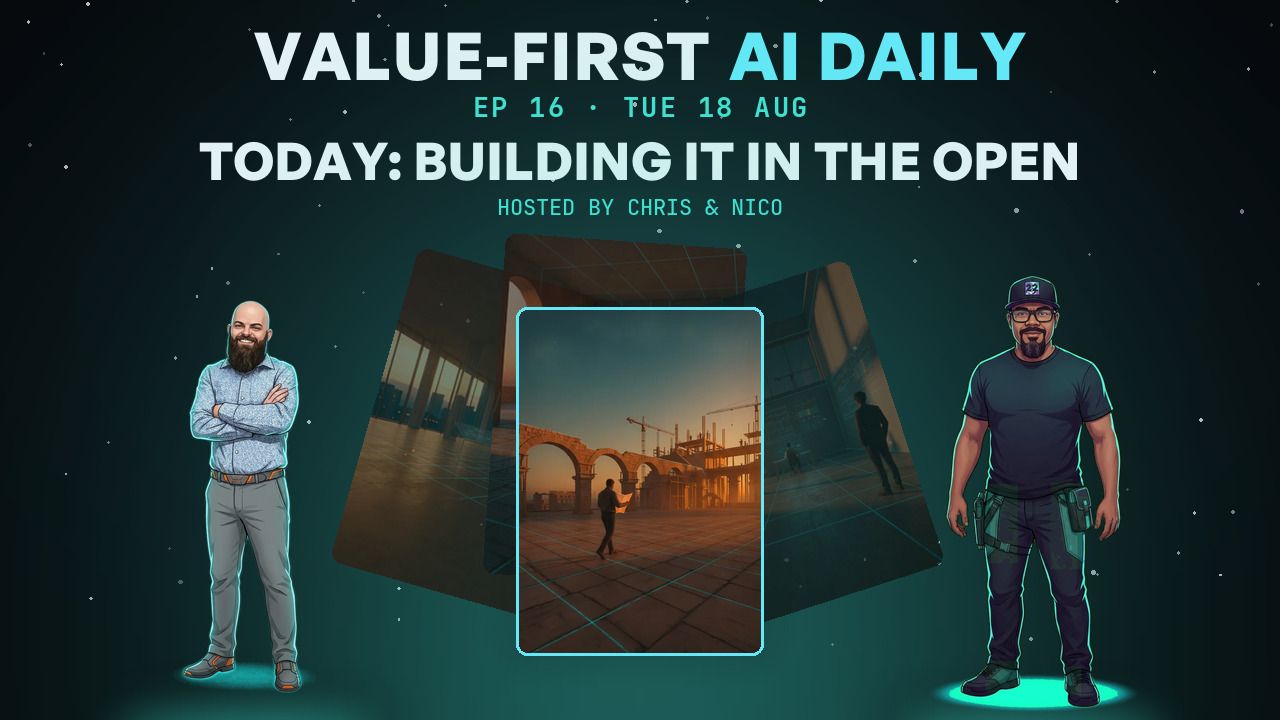
Chris Carolan and Nico Lafakis open on a sealed three-story board neither host has seen: Alibaba's open-weights Qwen3.8 27B, Stripe's reported purchase of OpenRouter, and Nvidia's $105 billion financing for an OpenAI data center in Ohio. The Ohio story becomes the longest stretch of the episode - city councils, moratoriums and local opposition read as the real ceiling on compute, argued by a host who attends those meetings himself. From there the show goes off its own plan into the open-source model race, why a free local model may be enough for most of what most people do, and a live look at a build in progress, including the honest split between the human's ideas and the AI's.
Moments from this episode







Key takeaways
Alibaba's Qwen3.8 27B ships with open weights as a seventeen-gigabyte file under an Apache 2 licence, and on the lab's own figures it passes the lab's strongest closed model from May — a capability you can run on a well-specced laptop with no vendor account at all.
What a model ships set to matters more than what it can do. At its default reasoning effort, one hands-on test of that model spent 22,276 thinking tokens and twenty-one minutes on a drawing that took 137 seconds with reasoning switched off.
If the only thing you were ever going to do was use a chat assistant, learning to download and run a local open-weights model is a genuine substitute. The claim on air was "you have a free language model forever," and it was made twice, deliberately, as "not a misstatement."
Do not benchmark a model built for local use against cloud models designed to serve everybody at once. The question that decides the choice is how much model the work actually needs.
Stripe's reported purchase of OpenRouter moves the neutral place builders compare price per unit of capability across labs inside a payments company — and on air it was read forward as groundwork for agent payment rails.
The binding constraint on new AI data centers in the US is no longer capital. It is city councils, judges, moratoriums and organized local opposition — and Nvidia's Ohio financing came in at less than half the backstop originally planned.
Demand for compute and opposition to compute are two different facts, and conflating them produces bad reads. The argument on air was that there is no bubble under the demand; what went unpriced was the reaction of the towns.
Small gaps on a benchmark chart are not small in practice — a few points separates a model that survives a long-horizon task from one that hits a stumbling block on it. The chart shown on air was not identified by name, so its numbers are not reproduced here.
Open-source models are closing on the frontier fast enough that "which model is better" stops being a conversation. The prediction stated on air: by December the outputs are indistinguishable, and nobody cares next year.
A one-shot prompt will not produce a finished product. The host demoing his build put the human-to-AI idea split at roughly 75/25 in his own favour, and named what one-shotting gets wrong: timing, physics, textures, and not knowing where anything is when it breaks.
An experience people remember beats a measurable click. The UNBOUND outreach described as working is a free online game with no sign-up and no email capture, offered as something to give rather than something to ask for.
Breaking things on purpose is survivable when recovery is cheap. Moving file paths under a live working system broke pointers all day and the commands recovered without missing a beat — the reason most people never move at all is a cost they have not actually measured.
Keep learning
You just watched the work. Now build it.
The next step is doing it yourself — live, with people on the same path.
One signal-dense note when a new episode lands. No noise.