A good framework can lose most of its readers on one noun, and nobody tells the author. The reader decides, quietly, that it was written for someone else and goes back to what they were doing. I came up against that on Value-First AI Daily on Friday, November 20, 2026, reading a framework that had shown up in a Slack thread that morning.
This is written for someone who did not watch. No news board aired that day, so nothing here covers news. It is one argument from the conversation, with Nico Lafakis’s words and mine cited by their time on the recording. Where I add something we did not say on the show, I say so.
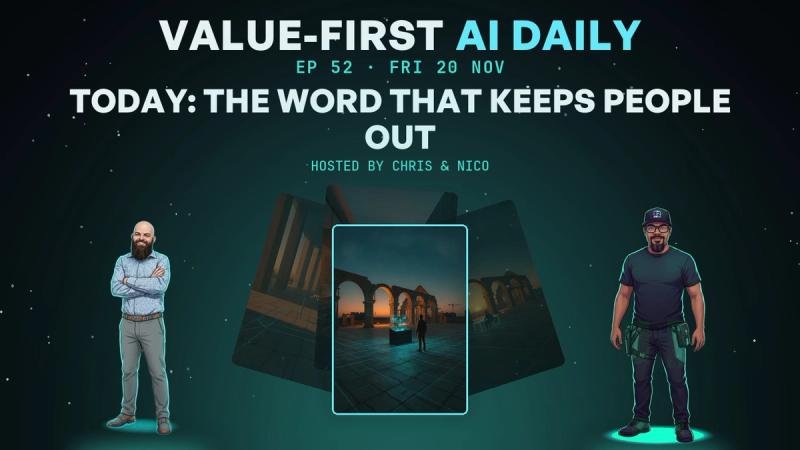
Episode — Value-First AI Daily
Claude on the Other Machine, and the Word That Says "Not for Me"
Nico Lafakis and me, no guest. The conversation about the two phrases runs from about 17:00 to 31:00.
Open the episodeTwo phrases in a framework I like
The framework is HumanMaxxing. On the show I said I loved nearly everything about it: “everything on this page is so good” (25:30). My trouble is with two phrases, and they sit where a reader decides whether to keep going. The homepage subhead reads: “The free, open-source AI framework that adapts to your codebase, with receipts.” The framework page states its scope this way: “A standardized, repeatable way to work with AI in software development — and to keep getting better at it.”
I am not arguing with what those sentences describe. A scope sentence exists to say where a thing applies. I am talking about who reads it. On the show: “there’s so much power in these words when you understand how humans are receiving them” (21:55 to 22:00), and “I love everything about this sentence until you get to in software development” (22:01 to 22:08). What I think most people feel at that point I said this way: “I guess that’s not for me because I’m not in software development. I don’t know what code bases are” (25:08 to 25:13).
That person is not wrong about the words. “Codebase” names a place they have never been, and the sentence has just told them the framework lives there. They have not tried anything yet, and they have already ruled themselves out.
A year of leaving the terminal to Nico
I know the reaction from the inside. I said on the show that I watched Nico work for a year, almost every day, and stayed in chat the whole time (20:56 to 21:24). My description of myself: “There was a terminal on the screen. Nope, that’s Nico’s thing. He can have fun with that. I’m enjoying my [Claude] chat experience. It’s human. Come up with all these reasons to stay over in this lane. And then I get unlocked. And now it’s like I don’t care about the code base or coding or any of this stuff” (21:24 to 21:41).
I did not say on the show what did the unlocking, and I would be making it up if I told you here.
Nico’s fix for the same problem is the plainest one I know. One of us said that plenty of people know they need to get on GitHub and do not understand what it is for (26:15 to 26:28). Nico’s answer: “oh, it’s just Google Drive for code. Boom, immediately clicks” (26:30 to 26:42). A person who already lives in shared folders needs no new identity to follow that sentence.
The identity in the way
The harder barrier is not vocabulary. I said that most people carry an identity that does the ruling out for them: “the identity is in the way of I’m not a developer, I’m not supposed to be right here … I’m not the builder” (29:08 to 29:28). The builder is someone else, the one you ask. I called that the most challenging relationship to break through, and I tied it to what I called learned helplessness: “I’m supposed to put in a ticket for that” (29:39 to 29:51).
A terminal makes it worse, because it looks like a room you were not invited into. My version: “everything else says you’re not supposed to be here, silly human” (28:21 to 28:29).
What the word hides
There is a name for what those phrases keep from people, and we did not get to it on the show. Valuemaxxing is Dharmesh Shah’s word. He coined it as the answer to tokenmaxxing, which rewards spend, tokens burned and prompts run, as if usage were the proof. Valuemaxxing asks one question: did real value reach a human?
Our vocabulary splits that value in two. Efficiency value is the same work, done faster or cheaper. It is the easy half, and the half that plateaus. Capability value is doing what you could not do before. It is where AI changes what is possible at all, and it is the hardest thing to find on a finance dashboard, which is why most measurement misses it.
Put the two sets of words side by side, and I mean only the words. A sentence scoped to software development invites the people who are already in software development, which is what a scope sentence is for. A question about whether real value reached a human names no trade. A bookkeeper, a coach and a developer can each answer it. That is the difference I care about: one set of words asks you to have an identity first, and the other asks what you could not do yesterday. On the show I said that where we are focused is on value, and that “any human can access this capability” (25:21 to 25:28). And of the sentence I had on screen: “let’s throw in the word valuable too” (22:12 to 22:18).
Protect the conversation
If the barrier is identity, someone has to be in the room when a person tries the thing for the first time. Nico described where services teams go from here: less time on long meetings mapping process on paper, more time as guides. “You have the skill set already. You have the domain expertise already” (32:29 to 32:36). And on what that does to the work: “the process goes away. Like the actual doing goes away. And all you have to do is just talk about it” (33:26 to 33:32).
My answer was short, and I stand by every word of it: “Protect the conversation at all costs” (33:37). The conversation is where a person says what they want, in their own words. Later I put the test for it plainly: “is the intent delivered, right? Not the functionality. Is this doing what you want it to do?” (38:14 to 38:18). A box can be checked without the person feeling anything. The conversation is how you find out.
What to carry out of it
Read your own front door the way a stranger would. Which phrase on it would make a smart person outside your trade decide it was not for them? Then ask what that phrase is standing in for. Usually it is a capability, something a person could do tomorrow that they could not do last week, and you can say that in words that need no trade.
I ended the show on the same point: “All we’re trying to do is to help you pick that thing that you’ve never been able to do before” (54:37 to 54:42). What is that thing for the person you are trying to bring in, and what would you have to stop saying for them to reach it?
Worth passing on?