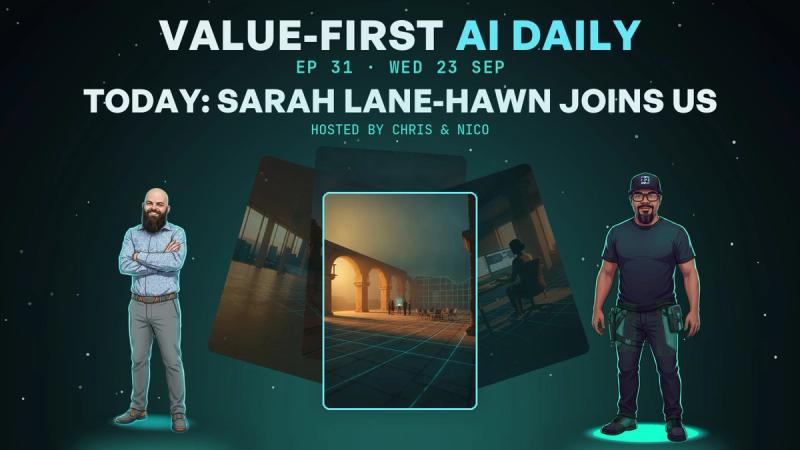

Chris Carolan and Nico Lafakis's first Value-First AI Daily since HubSpot UNBOUND opened on the calendar itself. "We lost 10 days somewhere, man," one host said eighteen seconds in (00:18). He'd spent the day before catching up: "I took all day yesterday to summarize videos and lectures and read-through reports and releases and changes and updates" (01:11).
By the time the board came up, the gap was flagged out loud. "It's a top three since we saw you, since our last show, not yesterday," Chris Carolan said (34:15) — the usual window widened to cover everything since the prior episode. What came back across it: a CRM vendor opening a door into live customer data, a parliament asking who answers for a model's mistakes, and a lawsuit built on the idea that talking publicly about caution can itself be illegal.
Salesforce Opens a Door It Didn't Build
The story that led the board wasn't a new model release. Salesforce turned on a beta that lets Claude read and act on live CRM data under a customer's existing permissions — no separate integration, no new data pull to authorize. Dreamforce paired the release with Slackforce surfaces and an Agentforce Coworker built into Lightning, plus 37 prebuilt sales skills packaged as an MCP plugin. Updates get proposed in chat now, not written through a side channel. The sealed board's own read on what changes today: HubSpot-native teams already have this pattern; it's Salesforce's own customers who were waiting on the plug-in.
One host had already flagged how personal his reads get, earlier in the same hour — "'cause it's not the opinion of Value-First or the Value-First team or Value-First AI Daily," Nico Lafakis said (14:31). The reaction once the board reached Salesforce ran the same way. "The DNA of Salesforce was dehumanizing all of these processes," Chris Carolan said. "That's where this lead object came from" (51:38). "It is not in their best interest to make it easier" (52:21), he added. Of the 37 prebuilt sales skills bundled into the release, Nico Lafakis's only question was "Why do you need that many?" (53:13)
A Parliament Wants a Name to Call
The second story: UK MPs summoned OpenAI, Anthropic, Google DeepMind and Meta to a Business Committee hearing on mandatory AI safety testing. The letters ask three plain questions — should pre-release testing be written into law, what access should the UK's AI Safety Institute have to models and training data by right, and who is personally accountable when a frontier system ships and something goes wrong. All four labs have until 29 September to confirm they will attend the 13 October session. Nothing here is a rule yet; a summons gets an answer, not a statute.
One host called the news cycle exhausting, then reframed it: "I'm already tired of this new cycle," he said, "but this is the transition that we've been talking about" (40:43).
A Lawsuit That Calls Caution Collusion
The story that closed the board — read first, since the order runs third to first — was also the one neither host expected. A group of paid subscribers filed a complaint in the Northern District of California on 19 September arguing that Sam Altman, Elon Musk and Demis Hassabis, all replying the same day to Dario Amodei's 12 September essay on AI safety, were not three competitors independently urging caution. The complaint names Anthropic, OpenAI, SpaceXAI and Google as defendants and casts the exchange as rivals agreeing to compete less on capability. The plaintiffs say they don't oppose any one lab pausing on its own; what they contest is collective restraint reached without a government waiver. In plain terms: talking about slowing down together is being argued as an antitrust problem.
Chris Carolan's first reaction was disbelief. "What? Who's behind this?" he said (35:51). Nico Lafakis didn't share the doubt. "Look, all I can tell you is that it's not a joke," he said. "That's all I can tell you. It's not a joke" (36:30). The board's own read sits between them: an unproven class complaint, not a ruling — a legal-risk signal, not settled antitrust law.
What the Board Didn't Have Time to Cover
None of the three stories mentions what both hosts spent the hour before the board actually arguing: that the fastest way to get ahead right now has nothing to do with who owns the CRM object, who answers to Parliament, or who gets sued for saying a word out loud. "One of the best things you can do with AI is to show it what worked, and then reverse engineer everything that happened before it," Chris Carolan said (04:23) — aimed not at a vendor or a regulator but at every team still buying more data instead of using the data already sitting in its own inbox. Four minutes later, Nico Lafakis landed on nearly the same line from the other direction: "Reverse engineering is the most powerful tool in your kit right now" (08:48). A CRM vendor opening a door, a parliament asking who's accountable, a lawsuit over who gets to talk about slowing down — three fights over control, read back to back. The fourth option, running underneath the whole show, was never in a fight with anyone.
Episode — Value-First AI Daily
Back from UNBOUND
Chris Carolan and Nico Lafakis, back from HubSpot UNBOUND, September 22 — reverse engineering over attribution, then the sealed Top Three since the last show (around 55 minutes).
Open the episodeThe show closed the way it usually does, forward-looking. "We will be back tomorrow and we might have a special guest joining us tomorrow," one host said (55:06). The guest showed up the next day.
Worth passing on?