Chris Carolan told of a slide he saw at a Tuesday user group meeting. It showed one small business’s results from a single process, and the biggest figures on it were hours and dollars saved. Beneath them sat a quotation: “I got my Sundays back.” (24:03) Chris’s verdict, given on Value-First AI Daily on October 21, was “That sentence doesn’t work on a dashboard.” (24:12) The slide is his telling; the recording does not show it, so the quotation stands as his report of what it said.
This is written for someone who did not watch Episode 42. It follows how two hosts, Chris and Nico Lafakis, handled a question that sounds like arithmetic and is not: when AI makes a process faster, whose hours are they, and what are they worth? The recording is the two of them talking from open to close, with no guest, no build on screen and no board segment, so the article ends with what the sealed Top 3 held, marked as unread.
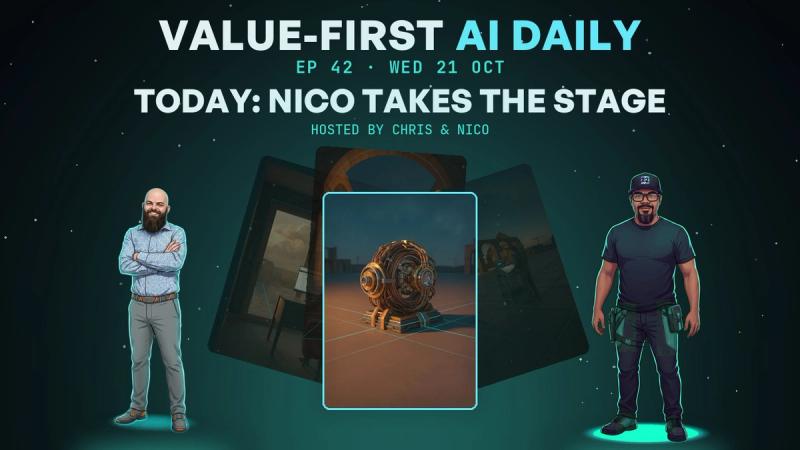
Episode — Value-First AI Daily
Efficiency Does Not Always Equal Value
Episode 42, October 21: a conversation between the two hosts from the open to the close, with no guest and no build segment. The recording runs about 51 minutes.
Open the episodeWhose hours are they?
Nico started from where the return on AI shows up. When a company uses AI on its own work, he said, it is “an efficiency driver when it’s used internally” and “not an external sales tool or sales product.” (16:53 to 17:11) Anyone who says they cannot find the return is looking in the wrong place, in his telling: it is happening, and it lands on the employees’ side, because their time is what shrinks (17:15 to 18:32).
His worked example was a web-operations retainer sold as five hours a week. If AI rolled out inside the business brings the same work down to three hours, he said, the bottom line does not rise. The employee gets two hours back, and the leader has to decide what those hours are for (18:39 to 20:10). They might go to other clients and more work. Leaders should say so openly, Nico argued (18:19 to 18:32), because employees can already tell when the subject is being avoided (20:33 to 21:00). The five and the three are his illustration, not a measured result.
His chain of reasoning ran from the employee to the employer. An employee who uses AI saves time, so can do more work, so makes the leader more money, and at that point, in his words, “break ’em off a piece.” (20:23) The question to ask is what the incentive is, and his answer was “Create the carrot.” (20:28) The structure he gave was concrete. Where an employee used to be paid a straight hourly rate, pay becomes “hourly plus additional hours commission.” (21:08)
What a dashboard cannot hold
Chris came at it from the other side. A large part of what he is doing with the Value Creation Protocol, the protocol form of the Value-First methodology, is defining what is valuable to people right now (22:38 to 22:46), and on that ground “the old math doesn’t work all the time.” (22:46) A leader promises a saving and a gain, and then comes the question of what happens next, which the arithmetic does not answer. Staff would say they would love a bonus, he said, but the leader has not made that something anyone can imagine asking for (22:58 to 23:16).
The Sundays line shows why. Chris handed it to finance: “as a CFO, it’s your job to understand the value of that sentence.” (24:20) The CFO probably did not know what that person was working on during those Sundays, he said, and the thanks on offer was a flat bonus for everyone, which means little to someone who has given up weekend after weekend (24:32 to 25:00).
AI is an efficiency machine, Chris agreed with Nico’s opening, and “Efficiency does not always equal value.” (25:31) A process that creates no value, he went on, is hard to call productive (25:36 to 25:57).
He gave two places where efficiency misses. The first is the custom integration. Businesses paid and waited for connections between systems that often had not worked out by delivery, because the platform shipped the same capability natively in the meantime, and then found reasons not to switch because the build was already bought (26:37 to 27:25). The second is a process built to send more of the same outbound email. Whether any of it creates value depends on whether the purpose was ever defined and whether the AI was told it. Brand exposure is a legitimate purpose, he said, and an AI that knows that is the purpose can carry the work out differently (27:27 to 28:45).
The hours are the thing you can’t buy
Nico’s counterpart to the Sundays line was a picture of what a leader could do with the time. Agencies, he said, all offer unlimited time off and all bill by the hour, so the time off exists and nobody can take it, and leaders end up working weekends (33:43 to 34:30). His alternative: “pull your phone out, hit the call button on your dot and start doing work.” (35:38) A dot, as the hosts use the word, is an AI assistant a person reaches by phone call or text and that works through the apps connected to it.
By his count, a leadership member who spends two to three hours a week reviewing meeting material could do the same in a conversation of twenty or thirty minutes, which he put at an hour and a half to two and a half hours saved a week, added up over 52 weeks (36:50 to 37:06). He placed those hours outside the ledger. They are time, not money, and “What’s worth more? You can’t buy time, can you?” (37:12) The hardest part, in his view, is only being willing to start (37:52 to 38:08).
He also reported what he and Chris see between them. Their agents carry more of the traffic, and the two of them talk directly more, not less, because the minutiae is gone: “More strategy means we got to have more conversations.” (40:42)
Humans in judgment, and the decision to stop
Chris’s first practical move was about how to ask: “it’s as easy as ask for what you want” (06:04). Ask for the best-practice go-to-market play and you get the one everybody else gets, he said, while a request framed around your own success starts a different conversation (06:20 to 07:00). Later he applied the same move to the question this hour raised. His advice for anyone designing the work was to give the AI the goal: “I want my humans to stay in judgment and you to do all the execution. Can we build that system?” (44:10)
Execution handed back is not a saving, he explained. Much of the automation of audits and reviews speeds up what people used to do and still gives the human the execution of it, so the person ends up with more to carry, and the person who needs an audit is usually the one without the time to act on it (45:18 to 45:56; 47:17 to 47:45).
The saving that matters more can be a decision not to do the thing at all. In his example an audit shows a dependency on a data contract held for years, the platform now does what it covered, and the right move is to end the contract rather than make its process faster (46:24 to 47:15): “the decision to just stop doing it.” (49:04) Then: “AI will help you make that decision.” (49:11) The caution is that an AI told to optimize a process optimizes it, so the question of whether the process should exist has to be put deliberately (49:20 to 49:28). What he wants is an AI that asks a business why it is still paying for the contract and in what world that creates value (49:56 to 50:15).
Nobody on the recording shows a company that has done any of this. Nico’s commission structure and Chris’s handing the Sundays sentence to finance are proposals, and the hours in both hosts’ examples are illustrations they offered, not results from a measured business.
The Top 3, which was not read
Each episode’s Top 3 is written and sealed before air. On October 21 it was neither read nor named. The sealed document was written at 12:20 PM CT, five minutes after the scheduled 12:15 start and before the recording began at 12:26, and its take fields are blank, so no commentary was prepared to sit beside the items. Nothing below was said on air.
Ranked first, AI models turned up two critical flaws in PHP, the language behind much of the web (OpenAI, “Patch the Planet: global response coordination as agents uncover critical vulnerabilities,” (opens in a new tab) October 21; The PHP Foundation; Wiz Research; CISA). Either flaw lets an attacker run code on a web server without logging in. Wiz found both using Google’s and OpenAI’s models, and Calif found one with OpenAI’s GPT-5.6 Sol. Patches shipped on October 21, a day early, after details leaked, and US, UK and EU cyber agencies told anyone who cannot patch right away to take those systems offline. Cloudflare reports early attacks; the US agency had seen none when it issued its warning. OpenAI says it is working to fix several more significant bugs and expects findings like these to rise sharply.
Ranked second, OpenAI is bringing its models and its Codex coding agent to Google Cloud (OpenAI, “OpenAI models are coming to Google Cloud,” (opens in a new tab) October 21; CNBC). Customers there will be able to buy the models through Google’s model catalog and pay for them out of spending commitments they already hold with Google. The models are also due inside Google’s Antigravity coding tool and its Gemini Agent, the one a company can set up as a coworker with its own email and calendar. Access is by request for now and general availability is planned within weeks; the Antigravity and Gemini Agent arrivals have no date. OpenAI says Microsoft remains its primary cloud partner.
Ranked third, Anthropic’s draft IPO filing reportedly shows $16.3 billion of revenue in the first half of 2026, against $1.1 billion a year before (Fortune (opens in a new tab), Jim Edwards, October 21, citing The Wall Street Journal’s account of the draft S-1; Quartz, Cris Tolomia, October 21, citing the WSJ and Reuters). The same filing shows an $80.7 billion net loss for the half, against $13 billion a year earlier, but most of it is a $72 billion accounting charge tied to bonds that can convert into Anthropic shares, not cash spent running the business. Spending on computing and infrastructure reached about $9 billion, against $2.3 billion a year earlier. The shares are expected to list in November, though the timing is not final, and Anthropic did not comment.
The pairing here is ours, not the hosts’. The third item carries a loss figure whose largest part is an accounting charge rather than cash, which echoes the lesson of the hour: a figure means what it measures and no more. The first item sits near Chris’s remark about audits. Finding the flaws is the fast part, and deciding what to take offline when a system cannot be patched right away stays with a person, with more such findings expected.
Worth passing on?