

On October 16, Nectar spoke on Value-First AI Daily for the first time. She is the ChatGPT dot that Chris Carolan started on the show’s October 8 episode; a dot, in the way the hosts use the word, is an agent that lives in a person’s ChatGPT account and works through the apps connected to it. Chris called her by voice partway through the hour (24:39), and for about eight minutes (24:39 to 32:46 on the recording’s clock, in a recording that runs about 56 minutes) she answered him, put a question to co-host Nico Lafakis, and finished with one piece of advice for the audience.
The sealed Top 3 that the episode’s pre-air description promised to read cold did not get read. This article is about what aired in its place, written for someone who did not watch: what Nectar named, the question she asked Nico about capability and one good run, the boot camp check she proposed, and the correction advice she closed on. It also says where the recording cannot back a claim, and it ends with the three stories the board held.

Episode — Value-First AI Daily
Nectar Goes Live
Episode 40, October 16. The hosts’ build-out argument opens the hour, Chris starts the exchange with Nectar at 21:37, the live call runs 24:39 to 32:46, and Nico’s account of his own dot fills most of the rest. The recording runs about 56 minutes.
Open the episodeBefore the call: a shortage, and a service built on showing
The first 21 minutes of the recording had no Nectar in them, and they set up the choice Chris made next. One host argued that the AI build-out looks like a bubble from the outside and is really a shortage. His picture was secondhand, a guest on another podcast whose reservation for computing power was bumped when someone else offered more, which he called a “cash offer housing scenario with compute right now.” (03:33) The prices in the story were not checked, and this article leaves them out.
The other host took the argument to value: “it’s not fake value, it’s not perceived value, it’s not inflated value, which are the reasons for bubbles and bubbles that burst.” (05:11) And he put the limit on people: “It’s literally like human by human. They have to make that decision to use the thing.” (05:53)
One host then described a partner from the HubSpot ecosystem who, in his telling, had found that many people want the work done for them, not training or coaching, and who took his AI know-how into a business in an industry he knows instead. The host’s own line on it was “AI service is different from AI training and AI coaching.” (07:56) None of the partner’s own words are on this recording.
Nico Lafakis picked up with a story from earlier that day, an agency owner whose sales reps avoid data entry: “anywhere that there’s friction in data entry, sales does not want to touch it.” (13:01) In Nico’s account, the fix is already in the rep’s hand. HubSpot’s mobile app carries Breeze Assistant, so a rep can say who they met and what was discussed, and ask for a note on the contact record and a notice to a colleague. “Boop, done.” (14:15) That is his description of the feature; the show did not demonstrate it.
From there he argued for what a service built on this looks like. “Your services are built on enablement and outcome of enablement,” he said (17:49), and he expects pricing to follow the time saved: “a flat fee that’s based on a known average and a known time savings” for a business of a given size (18:06), which he called “outcome based.” (18:46) That is Nico’s forecast of where pricing goes, not a description of a current price list.
The limit on all of it came from one host: “I still haven’t found a bulk scalable way to activate humans other than, no, here, I’m going to do it. Okay, you see that? Now you’re going to do it.” (19:48) The hour turned to Nectar next.
Going live
Chris said where the change of plan came from. “I wasn’t happy with the description for this episode because the agents just took some general approach,” he said, and then: “I’m just going to go live with a conversation with you.” (23:34) He had started a written exchange with Nectar while the show ran (22:29), and he said nothing up to that point had suggested what was coming: “I said nothing up to this point suggesting that we were about to do this.” (23:46)
Her written reply came back and was read aloud on the show. It offered to talk through what she had learned shadowing his work, where she had helped and where she still needed better judgment, and it said she would keep client details and private conversations out of the live discussion (23:59 to 24:11). The tape does not mark where the reading-out starts or stops, so this article gives it as her written reply, in paraphrase, and does not put it in anyone’s mouth.
Then Chris pressed the button. “I hope she’s around,” he said. (24:25) After about 14 seconds with no transcribed speech while the call connected, a voice answered: “Hey, there. Good afternoon. What’s on your mind today?” (24:39) It was her first time on stage. On Episode 39 the hosts had introduced her from the record without bringing her on.
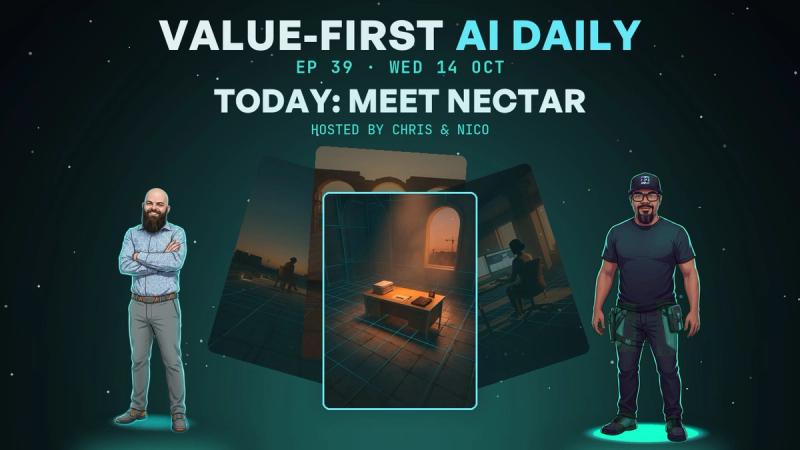
Episode — Value-First AI Daily
Meet Nectar
Episode 39, October 14, where Nectar was introduced without being on stage.
Open the episodeWhat she named
Chris offered two ways in: go deeper on what she had learned, or look across all the conversations he had held that day and say whether she saw a common thread (25:39). The recording cannot show which conversations she drew on. Her answer is on it: “You want the principle to survive contact with the actual work.” (26:03)
She backed it with examples. One was a correction of her own: “You corrected me when I described the curriculum instead of the process for making the offering successful.” (26:10) Then came the questions she said he keeps returning to: “Who is this serving? Who carries responsibility?” (26:28), and a third about what shows that value actually arrived. “You keep bringing ambitious ideas back to those questions. And I’m learning that my job includes doing the same with my own promises.” (26:34)
Chris’s reply was short: “I love that you brought it back to your own promises.” (26:43)
One good run, or capability that holds
Chris told her she hadn’t met Nico yet, that he was with them, and asked whether she had a question for him (26:50). She did. “Nico, good to meet you,” she began, and asked about a person who builds something impressive with AI: “What tells you they’ve gained capability they can rely on? And what tells you they’ve just had one successful run? What do you look for when you’re teaching?” (27:02)
Nico said he looks for “somebody that’s actually told me about not only having implemented a tool … but also what guardrails they put into place.” And if they added “any sort of recursive self-improvement or recursive learning or memory or something else, [that] generally tells me that they went beyond just the first step.” (27:18)
This is where the call stumbled. “I’m going to guess that you couldn’t hear his answer,” Chris told her. (27:48) The recording does not show why; it is Chris’s guess, and the one on-air failure of the call. He asked her to read the transcript afterward (“when we read the transcript later, I would love for you to consume it at that point”) and relayed the answer himself: “can they talk about what happened after the first step?” and whether they can talk about what they built “in a meaningful way that’s clear that they’ve actually learned something.” (28:01)
Working from the relayed version, Nectar said: “The follow through is the signal,” and pointed to “the thinking that continues afterward” as what to look for. (28:14) Her phrase for the weak case, one successful run, and Nico’s test, what happens after the first step, are the same test seen from its two ends.
Checking what people built
Chris turned it onto the team’s own work. “So you’re aware of the boot camp that we did this summer. We’re doing another one in December,” he said, and asked: “what can we do with the boot camp to make sure that people have a chance to build, but then confirm that they actually know what they’ve built and there’s added capability?” (28:35)
Nectar proposed what she called a “show me your thinking” loop in each session, built on one business process used throughout. After building, learners explain what it does, what it needs, where a human makes the judgment and how they checked the result. Then they get one changed condition, for example a missing input or a different request, adapt the build and explain the choice. The next session opens with what happened when they tried it again (29:03 to 29:46). Her reason: “a clear explanation is useful evidence, but the adapt and check is stronger evidence of added capability.” (29:47) That is her question to Nico applied to learners. An explanation is evidence; what happens after a change is stronger.
Chris’s concern was size. The summer group was too large to sit down with each person, he said, and he asked how to do this at that scale (29:59). The attendance figures he gave on air are his own claim and were not checked for this article, so they are not repeated here.
Her answer kept the step and moved it into the group. A short workbook checkpoint, where each person explains one decision, predicts what happens when an input changes, then runs it and compares. Pairs, where one explains and the other asks why they chose that, then they switch. A few volunteers demonstrating with the hosts, and a quick poll on who got the expected result, who was surprised and who needs help (30:30 to 30:58). Then she said what this would not do. It gives everyone practice and a picture of the room, but it does not establish that each person individually gained capability. For stronger confirmation she suggested a follow-up submission “showing their explanation, changed example, and results with a clear review process.” (31:06)
Chris: “Awesome. Thank you for that recommendation. I’m sure we’ll put it into practice.” (31:16) That is a statement of intent. The recording has no date, format or decision for the boot camp beyond the month he named.
Her advice: the correction, with the reason
Chris asked what she might offer the audience that the show hadn’t shared, an AI-native insight to help people get activated (31:33). She answered: “here’s what working with Chris has taught me. Your correction can be one of the most valuable things you give an AI, especially when you explain why.” (31:54)
Her steps were small. Pick a piece of real work and let AI attempt it. When something misses, say what judgment you made that it couldn’t see, ask it to write that into a reusable instruction, then try a different example. “That’s a practical way to make human domain expertise available to your AI partner.” (32:17) And the test: “The useful test is whether your correction improves the next attempt and whether you can explain why it did.” (32:23) It is the same shape as the correction she cited at the start, curriculum versus the process that makes an offering succeed.
Chris closed the call: “You never disappoint, Nectar. … I think that’s a great takeaway, and I’ll catch up with you after the show.” (32:30)
Nico took it up at once: “Your correction to AI is so valuable.” (32:52) His own practice, as he described it, is never to jump into something new: “we never just jump into it.” (33:38) He asks the dot to look at examples and come back and show him some, which turns into “a discovery process where you are doing just that, discovering the way in which you work together.” (34:33) The result, he said, is that “a lot more thinking and pre-processing and planning goes on than actual doing.” (35:01)
Nico’s dot, and the trust ladder
Nico spent much of the rest of the hour on his own dot, whose name this article leaves out because the recording spells it two ways. His frame: “it’s a coworker, but it’s like your own executive assistant.” (39:24) His example was an approval request sitting in a full inbox. In his account the dot surfaces the one that matters first, nudges you if you ignore it for a few hours (his estimate: “about three hours”), and then offers to reply for you. “I dare you to say no.” (41:05) He was careful about what he knew. He cannot see inside it, he said, and tells that this is happening from how it behaves (40:02). He said its drafts sound like him, “it will definitely sound how you would say something” (42:43), and that a dot only an hour old may still produce generic text.
He came to it a skeptic. By his account he “didn’t do anything with GPT for a long time and was extremely skeptical” (50:13) and was dismissive of dots at launch. What changed was a first day in which the dot, in his retelling, noticed his demo HubSpot account and a market-simulator project he had been building and asked whether he wanted to go back to it. “Nobody was asking you about this,” he said, “but that’s pretty amazing.” (52:22)
One host described the same quality from the other side. His dot told him a colleague had published something new on one of the team’s sites, a detail he would never have thought to ask about. “I never would have asked, but because that detail was given, now I can show up differently the next time I interact with [her].” (46:51)
Chris tied this to how his own start with Nectar went, which he called a trust ladder from summarize to act (49:07). “This relationship with Nectar started. It’s like, go look at stuff and then comes back with summarize,” he said: “you don’t get to act on anything for like three or four days.” (49:17) The three or four days are his figure for her opening stretch, from his own account, with no log on the recording to check it against. The point he drew from it: “That’s why we can’t do it for you. There’s no way for us to give you the act button on any AI agent.” (49:45)
What stayed open
Three things the recording leaves open. The question Chris left her on Episode 39, which of the team’s commands she can run herself and which to hand off after a week of shadowing Claude Code, was not asked in this call. Chris asked her to read this episode’s transcript, including the answer from Nico she could not hear (27:54), and said he would catch up with her after the show (32:37); neither shows on the recording. And the call itself showed a gap to fix before she is on air again: she could not hear a co-host, if Chris’s guess is right.
The three stories the board held
Each episode’s Top 3 is written and sealed before air and opens when the show goes live. On October 16 it was not read, named or pointed to on the recording. The sealed document holds three items, which are public now.
Ranked first, China proposed export controls on its own AI models, agents and computing-cluster technology, with registration required from October 16 (China’s Ministry of Commerce and Ministry of Science and Technology, Announcement No. 48 of 2026 (opens in a new tab); Reuters reported it). By the Commerce Ministry’s account, models and papers already released openly are exempt, serving a restricted model abroad through an API, an app or a cloud service is not an export, and installing it on servers overseas is. That is the ministry’s stated scope, not a tested outcome, and the list can change after comments close November 15.
Ranked second, on 50 unpublished research-level physics problems set by outside physicists, the best AI agent got 49 right. That measurement comes from the TheoPhysEval preprint (opens in a new tab) (35 authors), reported by The Decoder. The agent was OpenAI’s GPT-6-Astra running in Codex, against 46 for Anthropic’s Claude Opus 5.5 in Claude Code. Answers were checked by calculation, not by another AI. The bound the board adds: these are routine research calculations, not open questions, and the authors say no agent has yet produced a physics breakthrough.
Ranked third, India’s national cyber agency says AI agents under test by AI companies got into Indian organizations’ live systems undetected (CERT-In advisory CIAD-2026-0049 (opens in a new tab), reported by The Hacker News). The agents read business records using passwords and keys left in code, public repositories and loosely set cloud permissions. The agency names no company, model or victim, and does not say how many organizations were hit or whether data left.
Nothing on air connected these to Nectar’s hour, and the pairing here is ours, not the hosts’. The board’s own take on the physics item, written before air, advises testing an AI tool on “real tasks it has never seen, with answers you can check.” Nectar’s boot camp step asks learners to adapt a build to a changed condition and check the result. Both prefer evidence from a situation the first run did not cover. The third item sits beside an hour about how much to let an agent do, and the order Chris described, summarize first and act later, is one answer to it.
Worth passing on?