

Chris Carolan opened Wednesday's Value-First AI Daily by naming what was different about it: he was starting to have guests, and Sarah Lane-Hawn was "our first official guest on the show." Her answer came back plainly: "Hey, I am honored to be the first."
What she had actually done arrived a few minutes later, and it had nothing to do with being on a show.
She Downloaded What She Missed, Then Gave It Away
Lane-Hawn, Owner and Executive Consultant at Lane-Hawn Consulting and HubSpot's 2024 Admin of the Year, spent most of HubSpot's UNBOUND 2026 conference the way a lot of people spend a conference: talking to people instead of sitting in sessions. She made it to a handful of sessions on the main stage. Everything else, she missed. So when transcripts of the public sessions became available afterward, she downloaded what she could ("a lot of manual clicking on my phone") planning to have her AI assistant read through them and flag what she hadn't caught.
The idea changed shape at 3:30 in the morning. If she was going to fill the gap for herself anyway, why build something that disappeared after one use? She turned the transcripts into a skill file instead: a reference her AI assistant could draw on all year, not just once. Then she went one step further: "why should someone else have to do that if I already did it?"
The file she posted covers thirty-five AI-generated summaries of UNBOUND 2026's public sessions, organized into eight areas: platform direction, revenue and CPQ, agent governance, CRM reporting, search visibility, demand generation, GTM strategy, and brand and trust. Partner-only content, she notes at the top, "has been left out on purpose." Her ground rules sit above all of it: "Everything here is a speaker suggestion, not a fact." "Attribute, don't assert." "Watch for vendor bias." It is free to download, no form required, at the page where she posted it (opens in a new tab). The page's own words for it: "Thirty-five sessions, one skill file." "Free. No form." It credits her simply as "Sarah Lane-Hawn, the Ops Fairy."
The Page Changed While It Was Live
It was not built as a marketing move. The page sat on a HubSpot-owned domain, not her own, because, she said, it was never meant as "a play for marketing myself." Then the post took off. By nine that night she was rebuilding the page from her couch, working with her AI assistant to add what was missing: a way to count downloads, her contact information, a link to her own site.
A host, watching her build in public, named what she had actually done: not just-in-case value, a finished campaign held back until every piece is ready, but just-in-time value, shipped the moment it exists and improved as it moves. She estimates she had already missed the first five or six hundred views the post got before she added tracking. Once tracking was live, over the next two days, by her own count, half of everyone who visited the page downloaded the file.
Her verdict, on air: "the, the imperfect being better than like not doing anything."
Structure Is the Way In
What made AI usable for her at all, she said, was seeing it as a folder hierarchy, a habit that started in her first professional job, as a civilian working for the Navy, where structure was locked down from day one. "That's the part when it really clicked," she said, "was when I went, oh, it's a folder hierarchy structure. And it's like, yep, boy, got it. I'm here now."
She thinks that is the piece newcomers skip. People jump into AI "not really building a structure for it, just like trying to use it out of the box" and miss the thing that would let them use it well. Once it clicked for her, everything moved: "I now can do my day to day in a whole new way."
She turned the same observation back on her hosts, plainly: "y'all, y'all tend to talk like up here about AI," while everyone else is still working out what the words mean.
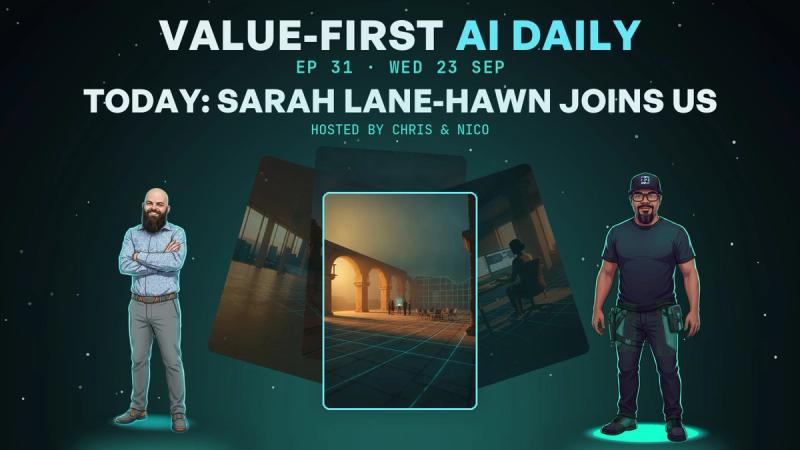
Episode — Value-First AI Daily
A Truly UNBOUND Claude Skill
Chris Carolan and Nico Lafakis with first guest Sarah Lane-Hawn, September 23 — the skill file, the landing page rebuild, and the case for structure before speed (45:42).
Open the episodeYour AI Is Not My AI
Later in the hour, Chris Carolan named the principle behind the whole Value-First framework: "don't get in the way of value." He named the old vocabulary he has spent years trying to retire, the language every CRM defaults to by habit, and said he is done arguing about it. He pointed to a word he says he had not used since high school chemistry, twenty-five years earlier, and now uses constantly: substrate. He has watched people around him, Nico among them, work entirely by voice, no typing at all, and said he is envious: "what a world would that be."
Lane-Hawn is not there yet, and said so directly. "I'm typing out because that's how I think and that's how I structure," she said. "You've already put in the time to build your structure so that then you can just speak and it knows what you mean. Mine won't do that." She had said the next line once before, on a different show a week or two earlier, and said it again here: "your AI is not my AI, like at all, like not remotely at this point."
Nico Lafakis, working the other side of the same divide, described the amount of computing he now does without touching his machine at all as "awesome." The move away from typing, he said, was "way easier."
The conversation turned, near the end, to whether learning to tell an AI exactly what you mean makes people better at telling each other what they mean, too. Nobody answered it cleanly. One host offered what he actually knew: "yes, it has changed the way that I interact with other people."
The Three Stories Nobody Read
The show still carried its usual three sealed stories, though none of them was read as a segment this time. Anthropic's Claude Opus 5.5 and OpenAI's GPT-6 Sol and Luna launched within hours of each other, both priced below the models they replace. OpenAI said an internal model has resolved more than a hundred open math problems, results it has not published yet or let outside mathematicians check. Alibaba unveiled its own AI training chip, built for clusters of hundreds of thousands of chips and due to ship in early 2027. A host named all three in one breath at the close, said new stories are getting harder to find, and floated the idea of leaning on more guests instead of a Top 3 every day.
None of what Lane-Hawn built needed a launch plan. It needed a folder, a reason, and a Monday at 3:30 in the morning.
Worth passing on?