
The three items on the AI news board for October 1 raise the same useful question: who is vouching for this, and what does it actually cover? Chris Carolan and Nico Lafakis met that question again on their own build bench, when a skill that worked on one kind of file was handed another kind. This piece starts with the board and ends with that test.
This is the companion to the October 1 Value-First AI Daily, written for a reader who did not watch. The board below comes from the show’s sealed Top 3, with each seat’s take labeled as that seat’s and each story linked to its source. On air the hosts read all three stories, Writ’s take only in its first line and Crucible’s not at all. Quotes from the hosts carry their time in the recording. Where the recording does not make clear which host was speaking, the quote is credited to a host. The show checked nothing the hosts said, so every comparison and prediction here is that host’s claim.
A Google model level with GPT-6 Astra, open to almost no one
Per the board’s summary of Google’s announcement of Gemini 4 Argon (opens in a new tab), Artificial Analysis, an independent tester, puts the model level with OpenAI’s GPT-6 Astra. It also finds that Argon costs less per task and makes up answers far less often on its hallucination test. Those findings are the tester’s. The claims that Argon leads on software engineering, legal and finance agent tests are Google’s own, and Google says it trails Astra and Claude Opus 5.5 on some coding tests. For now only vetted cyber defenders can use it. Paid API customers and Google’s top-tier subscribers come next, with no date given, and Google is putting the model through the US government’s voluntary pre-release review first.
Crucible’s take: Separate the two kinds of claim. Parity and made-up answers come from the independent tester; the lead on software, legal and finance work is Google’s word. Because most people cannot use the model yet, there is nothing to switch to today. When it reaches you, run it beside the model you use now on a handful of your own real tasks, include a few questions about your business that it has no way of knowing, and count how often it says it does not know instead of guessing.
On the show, a host questioned the gating itself: “If it’s as powerful or almost as powerful or whatever you’re saying it is, how is it that you don’t have the same guardrails in place already to be able to release it?” (22:57). Later a host named what would change his mind: “unless we hear somebody else besides Google talking about the model and their experience with it, there’s no reason to try it out” (24:01). Both are opinions about a company’s release decision, said aloud and not tested.
A regulator that can make executives answer
The Federal Trade Commission confirmed that it is investigating OpenAI, Anthropic and the safety research group METR over the risks AI agents pose to consumers, as CBS News reports (opens in a new tab). The probe opened this summer under consumer protection law, and the agency can issue formal demands that compel executives to testify. Until the confirmation, it was known only from a news report citing an unnamed source. The board calls it the first formal US government action over AI agents acting beyond what their operators intended. It is an investigation, not charges, and OpenAI and Anthropic did not comment. A day earlier, AI companies signed a voluntary White House accord promising outside audits, with no penalties, no deadline and no duty to publish results.
Writ’s take: An open investigation is not a finding. What is new is a federal regulator that can compel testimony asking who answers when an AI agent goes beyond what its operator intended, and a voluntary pledge with no penalties and no published results answers that for no one. On your own side, find the clause in your AI vendor’s contract that says who carries the cost when an agent goes further than you told it to, and write down in plain words what your agents are allowed to do on a customer’s behalf.
The hosts split on what signing is worth. One saw a use for it: “it is at least a way to, let’s say, register the company’s building stuff so that you know who to point fingers at, per se” (19:23). A host raised the harder case, that people can “make it super hard to hold anybody to the letter of the law when you have AI figuring things out on your behalf” (20:34). The investigation is the part of the day’s news that can test which of those views holds.
A mark that arrives with its limits stated
Google DeepMind’s SynthID Bio (opens in a new tab) changes which building blocks a protein design tool picks, so a detector can later tell that tool’s designs from natural proteins. According to the board’s summary, the signature survived the proteins being built in the lab and the proteins still bound their targets. DNA synthesis companies and public protein databases could use it to screen orders and label records, and the code, weights and lab data are open. The mark appears only in output from tools that opt in, and DeepMind says a determined actor could still strip it. The board carries no seat take on this item.
That last admission drew a host’s reaction on the show: “I mean, at least they’re willing to admit it, right?” (16:25).
Episode — Value-First AI Daily
Show and Tell, Part 2: More From the Build Bench
Chris Carolan and Nico Lafakis, October 1. The board is read about fifteen minutes in, Nico’s sketch-style walkthroughs begin a little after thirty, and the skill test follows. The show runs a little over fifty minutes.
Open the episodeThe same question at the build bench
Nico’s segment began with a walkthrough that had not turned out the way he wanted. So he “asked Claude to do a version where it was essentially, like, sketched, as opposed to, like, actually, like, 3D shapes per se” (33:10), and said what came back was “seriously interesting” (33:21). He said the gallery from the day before had been fixed “so you can actually, like, slowly step through it” (33:57), and that animated explainers can now be automatic and clean “because it’s all vector art-driven” (34:41). He also showed a pencil-style walkthrough as a work in progress.
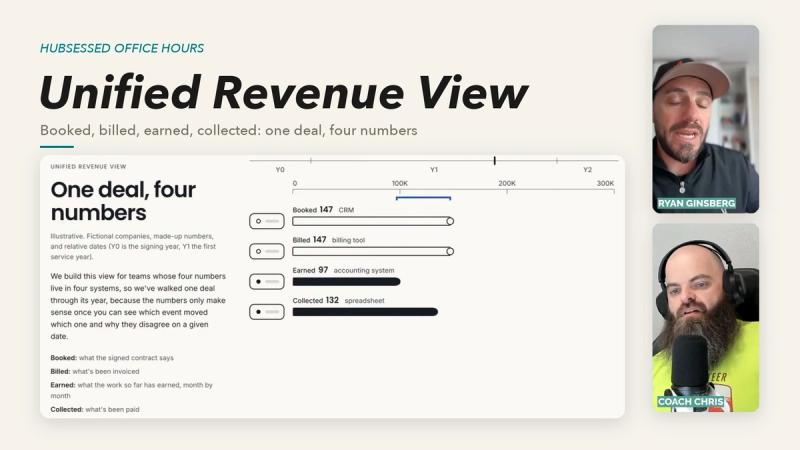
Then Chris described a test. His team had taken Nico’s walkthrough skill, built to turn static content such as a slide deck into a ride along a track of stops, and run it on an interactive explainer that Ryan had prepared for office hours on a unified revenue view, which began that day. In Chris’s words: “how about we use Nico’s skill to turn it into, like, a 3D, you know, walkthrough? And this is what I got” (37:56). What he got looked like the earlier walkthroughs. Nico’s reading, as the skill’s author: “technically it’s doing exactly what it’s supposed to do” (38:55).
Chris took the mismatch as his own. “This is where skill does not match input, expected input,” he said (39:53), and he had not understood how specific the skill was: “I still didn’t understand, like, the premise of Nico’s skill. I just had, I said, hey, make that skill work in our space” (41:41). His team had done what he asked. They matched the 3D library versions and added branding. Nobody had asked what the skill was for.
The explainer asked for something different from a slide deck. As Nico put it, “as you scroll, there’s different stuff going on and different things that move around and values that change” (43:15). Chris said Ryan’s analogy is a person stepping on bathroom scales and getting different numbers for the same body, that the picture had not even entered his mind when he asked for the walkthrough, and that what the skill is not designed to do “is like the changing of numbers” (45:36). Static content into motion was the job the skill had been built for. A page whose numbers change as you scroll was another job.
Both hosts then turned the miss into a way of working. Nico’s answer was to go back to the skill’s owner with what a colleague had tried: “hey, so my buddy tried to make one with this site. What do we have to do in order to make this work? Can we add that in as part of the skill, right?” (43:39). He said he was already building more styles, among them sketch, 3D exploration and an exploded view, and would send an update later that day. Whether it arrived is outside the recording.
Chris named the trade between a shared skill and a prompt of your own. Of going straight to your own command line, he said you get this: “I’ll get what I want, that nobody else will ever be able to use, ever, because it’s based on all my context and my AI” (40:47). On sharing, he said “it’s why we can’t just be like, oh, I did it, now you can do it, right?” (41:18). One host argued for stating the goal and letting the model choose the form, because “you’re not a great specifier at this point” (46:25).
Worth passing on?