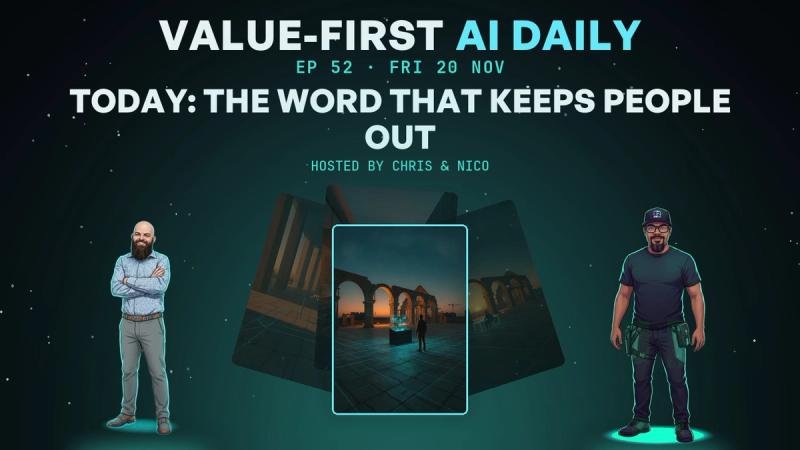
Chris Carolan described what happens when an AI does a job inside a record page: a scroll of text, which you can read line by line and still not know what happened. He said it on Value-First AI Daily, Tuesday, November 17, 2026, while Nico Lafakis had a 3D village open on the shared screen.
This piece is written for someone who did not watch. No news board aired that day, so nothing here covers news. What follows is one argument from the conversation, with the hosts’ words cited by their time on the recording. Where we join things up, or describe something that was on screen and never said aloud, we say so.
Episode — Value-First AI Daily
Agentville, and Why B2B Never Built Experiences
Chris Carolan and Nico Lafakis, no guest. The recording runs just under 58 minutes. Agentville is on screen from about 18:20 to 54:15.
Open the episodeA village for the helpers
Nico called his build Agentville and explained why he made it (18:48 to 21:00). His starting problem, in his words: “there’s still this aspect of having to go all over your machine and having to go everywhere in order to access things” (18:48 to 19:15). His answer was to give the AI helpers he works with one shared place to live, whichever tool each one runs in. He described a message board for each project, where he can leave a request for the helpers to take care of (20:42 to 20:58).
What we could see on screen was a town. The projects appear as buildings, the helpers as characters who walk between them, and clicking a building opens a room with a list of jobs. That description is ours, from the picture; Nico’s own words are above.
One thing happened that nobody said aloud. Somewhere between about 41:30 and 48:30 on the recording, a request left in one of the buildings was picked up by a helper and later showed as finished, while the hosts were talking about something else. We saw it. They did not narrate it, and we have not checked what the request produced.
Why nobody drew a workflow
Chris took the village as a prompt for a bigger question. Why did business software go so long with no experiences at all, and why was everyone fine with that (21:03 to 21:28)? His answer, as we heard it, was that there was never anything to draw. A workflow looks at a company record, then a contact record, then adds some data, then posts and sends, and he said it would have made no sense to show that as a small character walking around, because nobody in it is doing anything. It is the system running steps (22:11 to 22:38).
The step we add is the one he did not say in so many words: an agent is something that acts, so it can be shown acting. If that reading is right, it is why a village of helpers is a sensible thing to build now.
The text scroll, and what it costs a person
Chris gave the scroll of text a name, black box mode: you want the output, you never understand what happened to produce it, and yet every step went past on the screen (24:20 to 24:35). He added that he had not thought about it that way until the day before.
Our reading is that the trouble is not missing information. The information is all there, in a form a person cannot hold. A picture of who did what, in what order, gives them something to point at.
Nobody asks for it, then everyone wants their own
Of the hosts’ 3D views, Chris said, “Nobody’s ever going to ask for it directly” (47:09 to 47:25). Nobody requests a thing they have never seen, which is part of why it took someone building one for the idea to land.
Once someone has, the next step belongs to the person using it. Nico: “you can absolutely see how people are going to want to create their own interface for something like this” (27:51 to 28:01). Chris reduced it to a prompt that any person can now type, “make this make sense to me” (28:03 to 28:15). And Nico on why that matters: “now I’m just going to make it what I want it to be instead of having to wait for somebody else to turn it into that thing for me” (28:56 to 29:11).
Intention before speed
Chris was careful about the other edge of this. AI makes it easy to build a lot quickly, and “if that’s the reality, then intention means everything” (29:39 to 29:53). Ask for a bigger workflow and you will get one. His question was whether anyone wants it: “maybe the humans I’m working with don’t want to maintain that workflow” (30:46 to 30:51).
He did not argue for a particular picture, and neither do we. Later in the hour he said that if you can focus on what is happening in front of you and believe it and feel it, “it really doesn’t … matter what we call it at the end of the day” (51:12 to 51:24).
What to carry out of it
The next time an AI hands you a finished result, ask for it in a shape you can follow: what it was given, what it did, in what order, and what it left alone. Chris’s prompt is the shortest version. Then test yourself. Can you say in your own words what happened? If you cannot, the result may be right and still not yours to use. Which result on your desk today could you not explain to someone else?
Worth passing on?