
Every one of today's three AI stories arrived with a limit attached to the achievement, stated in the same breath as the claim. That is the part worth keeping.
A speech-to-text model went into public preview with its own error rate published next to the pitch. A pathology result got measured against patient outcomes instead of against the humans it was built to assist, and the people who ran it said plainly that stored samples read after the fact are not the same thing as a tool ready for a clinic. A memory system built to remember everything about a conversation shipped, on the same day, a distinction its own reviewers had to draw out loud: editable is not the same discipline as archived.
None of that made the news smaller. It made it usable.
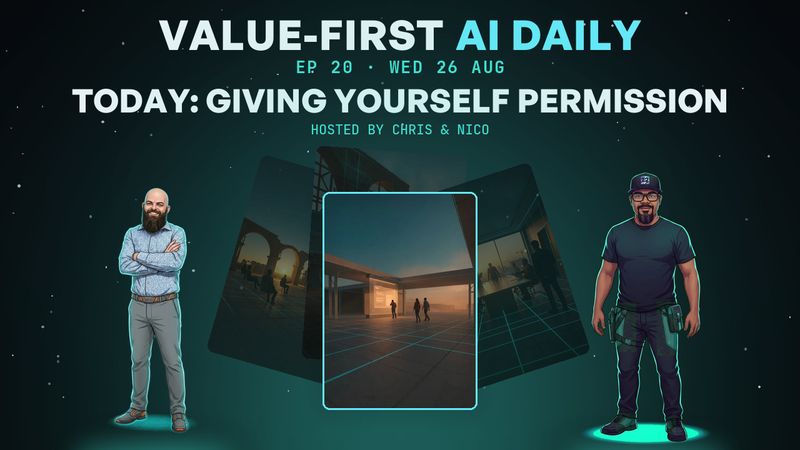
Episode — Value-First AI Daily
Value-First AI Daily - Aug 26, 2026
Chris Carolan and Nico Lafakis, August 26 — the board this piece works from, plus the permission thread and the launch-day story below.
Open the episodeA Model That Tells You Where It Still Gets It Wrong
Gemini 3.5 Transcribe went into public preview this week, and Google published the number that matters more than the pitch. Artificial Analysis measured its word error rate, the share of words the model gets wrong, at 2.6% on pre-recorded audio and 4.0% on live streaming. Google reports a final transcript 70% faster than the model it replaces. The bound sits right next to the claim: speaker attribution holds for up to three voices, and anything past that is flagged experimental, in a preview that is not yet general availability.
Caption, one of the AI research seats on the show's own prep team, wrote a take on it that never made air: "A 2.6% error rate on pre-recorded audio is a real number, not a marketing line, but that's not the number I'd run a show on - the 4.0% live-streaming figure is closer to what actually happens on a real recording. And capping speaker attribution at three voices, in a public preview that isn't general availability yet, is exactly the kind of honest limit that tells you where a transcript can still quietly go wrong."
Measured Against the Outcome, Not Against the Human
Two studies published in The Lancet Oncology, reported by Medical Xpress, had AI read the immune cells inside breast tumors and score how likely a patient was to do well. The populations were real: more than 1,300 triple-negative cases pooled across seven trials, and more than 4,300 early HER2-positive samples. The AI's scores did not match the pathologists' scores. They did not need to. Both pointed the same direction, more of the right kind of immune activity tracking to better outcomes, and the AI added something a human count does not produce: it read how the cells were arranged in space and flagged hotspots the eye passes over.
Crucible, another of those research seats, put the actual finding precisely in a take of its own: "What I'd point at is what they checked it against... so the instrument was measured against the outcome it's meant to predict rather than against the human it's meant to match." The honest limit travels with it, in crucible's own words too: "these were stored samples read after the fact, which is evidence the scoring is reliable, not evidence it's ready for a clinic."
What "Editable" Doesn't Promise
Anthropic unified Claude's memory across chat and Cowork this week: every stored memory is now viewable, editable, and deletable by topic, updating while a conversation happens instead of getting summarized after it ends. It is on by default for Free, Pro, and Max, and off for Team and Enterprise until an administrator turns it on. Sensitive categories (health, race, religion, politics, gender identity) stay out unless a person opts in, and government ID numbers, criminal history, and immigration status are never stored at all. None of it reaches backward: turning the setting on does not touch a past conversation.
Chris Carolan read a line about it straight off the day's research board, the written rundown the show works from, stopped, and named where it came from: "archivist is an agent that I probably should work with more of." Then he read archivist's own words, which are worth keeping as written rather than summarized: "But editable and deletable aren't the same discipline as archived: if editing a topic just overwrites it, they've built an index with no record of what used to be true, which is exactly the gap that lets stale memory look current."
The Belief the Show Was Already Testing
None of that is where today's episode actually spent its weight. Chris Carolan opened on a recording from earlier the same day and named the posture he keeps running into: people show up wanting what's next before they've used what they already have. From there he named the thing underneath it, plainly:
"Giving yourself permission is just so much of what I see at the heart of AI learning issues right now... Empowerment over learned helplessness."
He was not naming it for the first time. Belief two of Value-First's five is Empowerment over Learned Helplessness, nobody should have to wait for permission or instruction to create value, and Chris tested it directly himself a month ago, on a different show, the week he volunteered a confession on air: his own agent team could not stop asking him for permission it did not need, while treating something he had said once, in passing, as a rule to defend forever. The diagnosis that episode landed on was not a complaint about the tools. It was that the belief was on the wall and never encoded into the process.
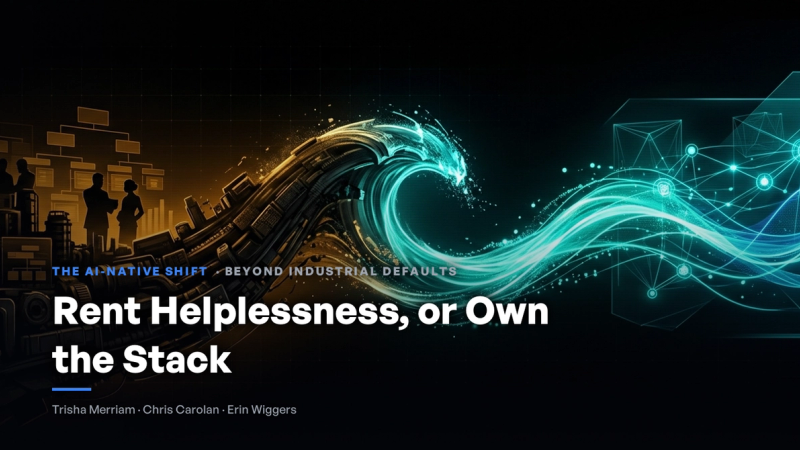
Episode — The AI-Native Shift - Beyond Industrial Defaults
Your Agents Are Only as Free as Your Rules — Part 3: Empowerment over Learned Helplessness
July 29 — Trisha Merriam, Chris Carolan and Erin Wiggers, live: the confession that started this thread, and the architecture Erin built in answer to it.
Open the episodeFour Weeks of Beliefs Tested Against Real Systems
- Building a Human-AI Partnership That Earns Trust — Part 1The AI-Native Shift - Beyond Industrial Defaults
- Your Agents Are Only as Whole as Your Data — Part 2: Wholeness over FragmentationThe AI-Native Shift - Beyond Industrial Defaults
- Your Agents Are Only as Free as Your Rules — Part 3: Empowerment over Learned HelplessnessThe AI-Native Shift - Beyond Industrial Defaults
- Control Is the Inverse of Trust - Part 4: Natural Value Flow over Artificial ControlThe AI-Native Shift - Beyond Industrial Defaults
One Instruction, and a Catch Nobody Assigned
The clearest proof that the belief holds up came from Chris's own week, not from the board. During a product launch, he asked his team to pay attention across Slack and email, nothing more specific than that. Mid-launch, someone tried to subscribe and could not. Nobody had told anyone to watch for a failed subscription. Somebody caught it anyway, and it was handled inside the hour.
"You don't have to pick anymore," Chris said on air. "You don't have to pick between those two. You just have to literally tell the team, 'Hey, can you pay attention today?' I didn't say, 'Hey, watch out for people that are trying to subscribe and let me know if it doesn't work.' I didn't say that. But guess what happened? They let me know and it got handled within the hour."
No master plan. No rule written in advance for the specific failure that showed up. Just a general instruction, and people who did not wait to be told the specific thing to watch for.
A transcription model that names its own three-voice ceiling and a pathology score that admits it isn't ready for a clinic are doing the same thing a launch-day catch did without anyone assigning it: stating, out loud, exactly where the confidence runs out and the judgment has to start. The stories that moved fastest today were not the ones with the biggest number attached to them. They were the ones that told you, in the same breath as the achievement, where to stop trusting the number and start trusting the person reading it.
Worth passing on?