
The AcademyAdvanced
Build Your Own Agents, Skills & Commands
What you'll build
Your own working AI-native primitive set, built on valuefirstagent.com: a real agent (front-matter-valid, with a wired expertise reference), at least one skill (valid YAML front matter, correct tier), and one command (authored to the ratified command template) — all runnable, and put through a real 'does it operate?' certification the same way this org certifies its own agents.
The live cadence
How the live thing runs for this path.
Office Hours as a builder clinic to start — author between sessions, bring your agent/skill/command to be reviewed live by the faculty who own this craft (Aegis for agent quality, Hone for skill/command architecture). Cohort later.
The build, step by step
What you'll do, in order.
- Study the living architecture as worked examplesBefore building, study real ones: open a few agent definitions in the full VFT agent roster, read a skill's front matter, read the command template. The org's own architecture IS the textbook. (open any file under agents/, the roster orientation in agents/README.md, the index in agents/manifest.json, and .claude/commands/_TEMPLATE.md.)
- Author a skill that passes the front-matter contractWrite your first skill with valid YAML front matter (title, tier, load_discipline, category, owner_agent, provenance) and the right tier semantics. Keep the two axes distinct: `tier` is arch (always-loaded) vs domain (demand-loaded); `load_discipline` further says when a domain skill loads — always, demand, or per-agent. The contract is enforced, so 'valid' is objective.
- Author a command to the ratified templateBuild a command following _TEMPLATE.md: Purpose, Execution Context, Inputs, Flow, Procedure, Outputs, Verification — surface-agnostic, inheriting global rules rather than restating them; the five typed calls used correctly.
- Build and ground your agentOn valuefirstagent.com, build an agent and ground it the way this org requires: an expertise reference that equips it to challenge and lead — not a yes-man. Learn the three-leg standard: externally grounded, challenge-and-lead, certified-against. (agents/RE-ONBOARDING.md Gate 0 + checklist A.)
- Certify that it operatesPut your primitive set through a real 'does it actually run?' certification — the constructive-evidence model where the agent does one real task as proof, exactly how this org certifies its own. (the /certify model + lint pack-wiring checks.)
- Bring it to the builder clinicJoin Office Hours and have your agent, skill, and command reviewed live by Aegis (agent quality + re-onboarding) and Hone (skill & command architecture). The live critique is where a working primitive becomes a trustworthy one.
Where the build becomes real
You build it on valuefirstagent.com.
the build destination: author and run your own agent there, with a skill and a command wired to it. The most literal build handoff of all six.
Join
Join the next live session for this path.
Tell us where to reach you and what you want to build. We will send you the next live session details.
Keep watching
Recent conversations to learn from.
The Value PathSeptember 10, 2026
Your Post-UNBOUND Value Path
One week before UNBOUND, Chris Carolan and Joshua Oakes take the cold "got 15 minutes to talk about your Q4 goals?" message that floods every inbox before a…
Open the episode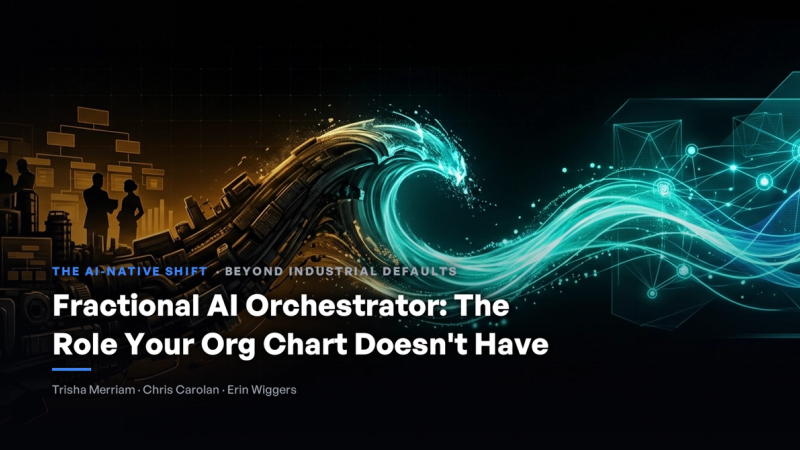
The AI-Native Shift - Beyond Industrial DefaultsSeptember 9, 2026
Fractional AI Orchestrator: The Role Your Org Chart Doesn't Have
Erin Wiggers has been sitting in a role no org chart has — fractional AI orchestrator for one of her clients — and she walks the room through what the job…
Open the episode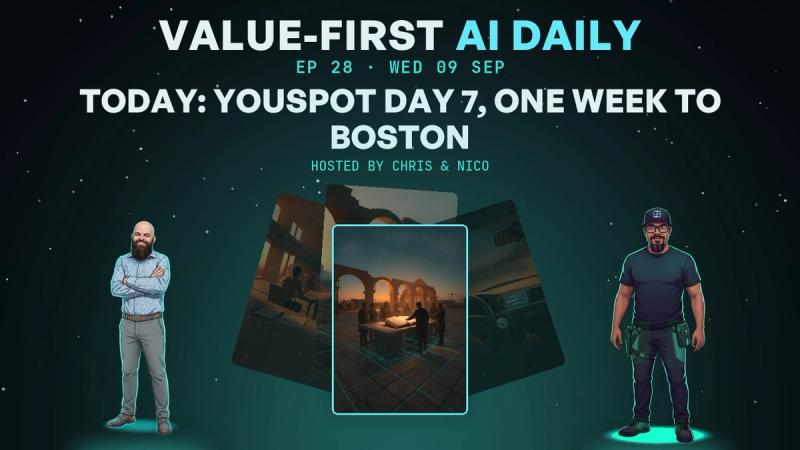
Value-First AI DailySeptember 9, 2026
Value-First AI Daily - Sep 9, 2026
Day 7 never happened. Chris promised youspot "in a few minutes" at 22:55 and never came back — the segment on a public MCP server that shipped over the weekend…
Open the episodeThe next step
You're building. Here's where it goes next.
And then, the rest of the path: